
Free SEO Proposal Template for agencies and freelancers
Create a winning SEO proposal on a customisable template with our free Proposal Builder Tool.
Start editing instantly and download in PDF – No login required
 Andrew Fennell | Last updated 24 September 2026
No account required ❌
SEO templates for agencies & freelancers 📄
Instant PDF download ⬇️
Fully customisable design features 🎨
Create a client-winning SEO proposal
This isn’t another generic proposal template that claims to be free, only to require a login or payment before you can download it or access the best features.
After years or receiving and sending my own SEO proposals, I thought the industry deserved better.
It’s a completely free SEO proposal builder created specifically for agencies and freelancers. You can instantly access and customize every section, add your own branding and pricing, and download a complete, client-ready proposal – with no account, subscription or hidden fees.
How the SEO proposal builder works
Create a tailored, client-ready SEO proposal in four straightforward steps.
1. Choose your proposal pages

Choose from 15 professionally structured SEO proposal page templates. Add or remove the optional pages to create the right proposal for each pitch.
2. Add client & project details

Enter the client’s objectives, current performance, priority keywords, forecast opportunities and proposed campaign activity. Pre-written SEO content is included throughout to give you a useful starting point.
3. Customise the content and design

Edit every section to reflect your pitch, adding your own services, deliverables, timelines, pricing and payment terms. Upload company logos and customise the colours, fonts, page textures and imagery to match your agency’s branding.
4. Preview and download your proposal

Review every page in the live preview and download the finished proposal instantly as a polished PDF without creating an account. Alternatively, create a free account to save your progress and return to it later.
What is included in the SEO proposal template?
The RevPages SEO proposal template includes 15 essential pages designed to give prospective clients the information they need to make an informed decision about your services.
Every slide is fully editable and can be included or removed to suit each pitch. You’ll also find expert-written SEO content suggestions and customisable design options throughout, making it easier to create a tailored, professional proposal.
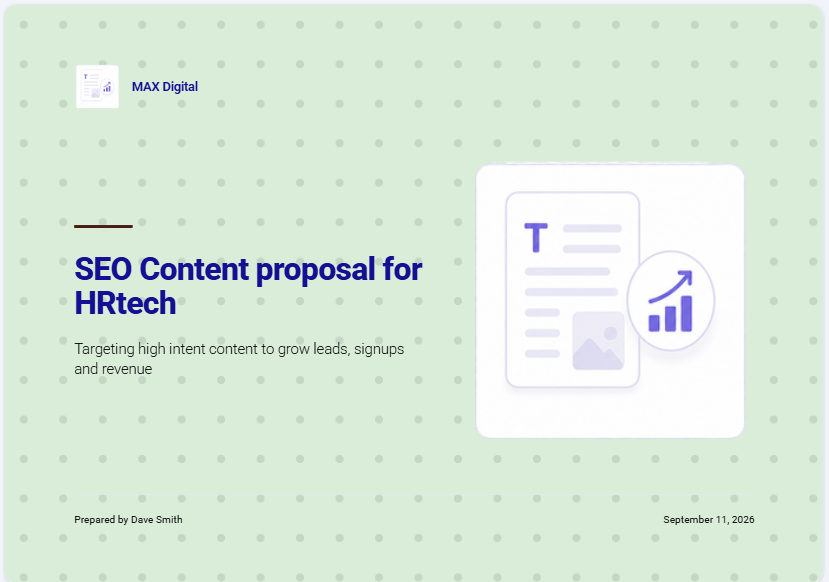
Cover page
Make a strong first impression with a polished, professionally branded cover page.

Cover page features
- Agency name and logo upload
- Proposal title
- Client name and logo upload
- Proposal creator’s name
- Proposal date
- Custom cover image upload
Tips for your cover page
First impressions matter, so use a title that reflects the strategy or outcome discussed with the client rather than simply writing “SEO proposal”. Include the name of the person who led the discovery call, keep the colours consistent with your agency’s branding and add both company logos for a more tailored, professional finish.
Proposal overview
Give your prospective client a concise overview of their current position, business objectives and your recommended approach.
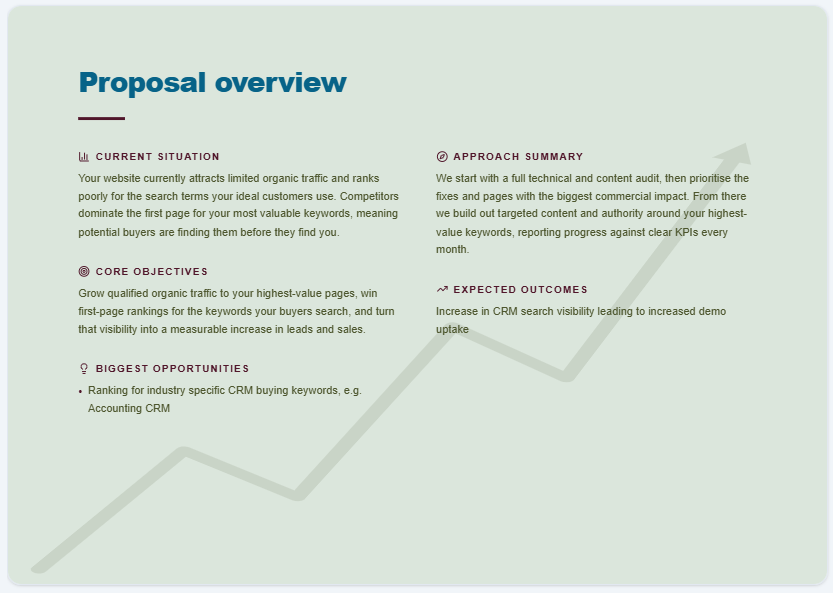
Proposal overview features
- Editable current-situation summary
- Editable core objectives
- List of priority opportunities
- Approach summary
- Expected-outcomes section
- Addable opportunity bullet points
Tips for your Proposal overview
Keep this page focused on the client rather than your agency. Summarise what they want to achieve, the obstacles currently preventing it and how your proposed approach will help. Use language from the discovery call so the client immediately recognises their priorities in the proposal.
Current SEO performance
Present a clear assessment of the client’s existing organic visibility and highlight the areas requiring attention.
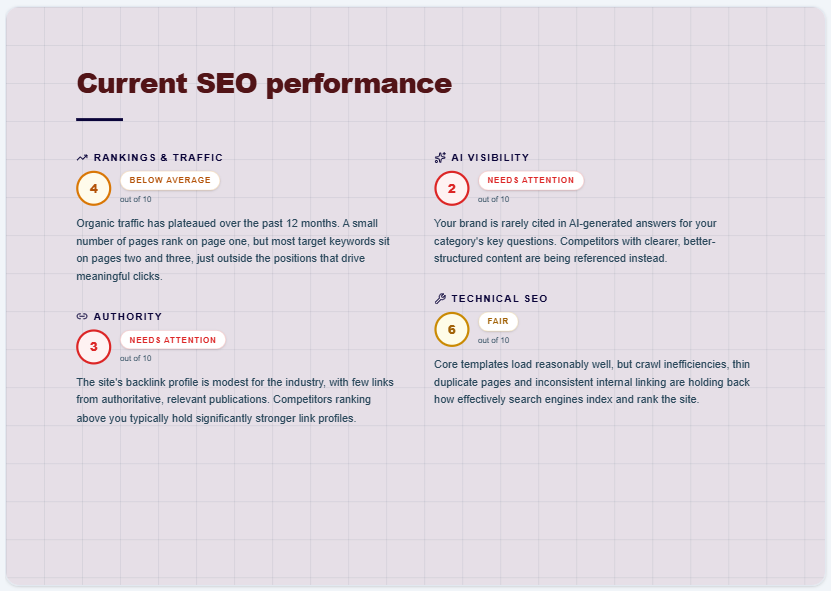
Current SEO performance features
- Rankings and organic traffic assessment
- Website authority assessment
- AI visibility assessment
- Technical SEO assessment
- Sales and revenue assessment
- Competitor assessment
- Editable rating icon from 1 to 10 for each area
Tips for assessing SEO performance
Base each score on evidence from your initial research and briefly explain what contributed to the rating. Be honest without making the assessment unnecessarily negative. The purpose is to establish a credible starting point and show where improvements can be made, not to criticise the client’s previous work.
Business SEO objectives
Turn the client’s commercial goals into a focused set of measurable SEO objectives.
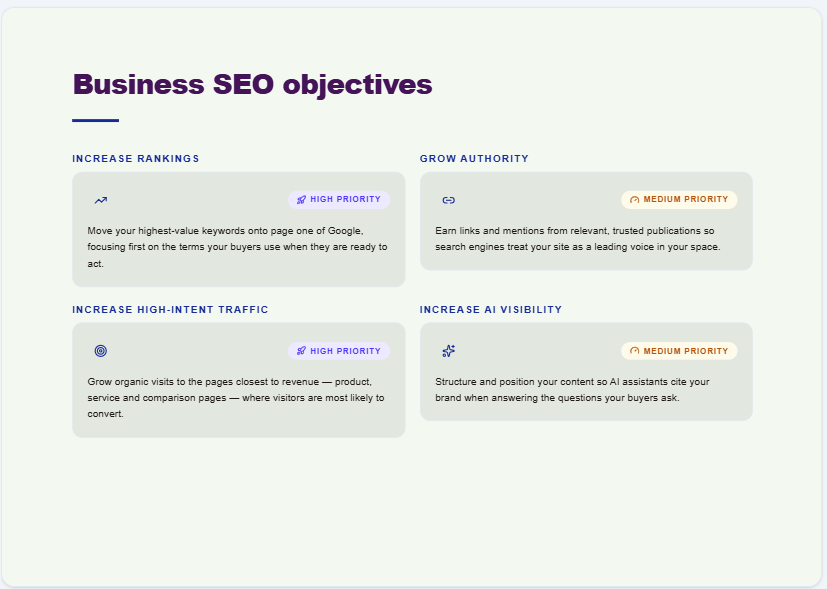
Business SEO objective features
- Increase rankings objective
- Grow website authority objective
- Increase high-intent traffic objective
- Increase top-of-funnel traffic objective
- Improve website performance objective
- Increase AI visibility objective
- Low, medium or high priority setting
- Editable objective headings and descriptions
- Add or remove objectives to suit the campaign
Tips for setting SEO objectives
Only include objectives that directly support the client’s wider business goals. Prioritise revenue, leads, sign-ups and commercially valuable visibility over vanity metrics. Keep the list focused so the proposal communicates clear goals discussed on the call, rather than attempting to address every possible aspect of SEO.
Biggest opportunities
Show the client the specific search opportunities that could generate additional traffic, customers and revenue.
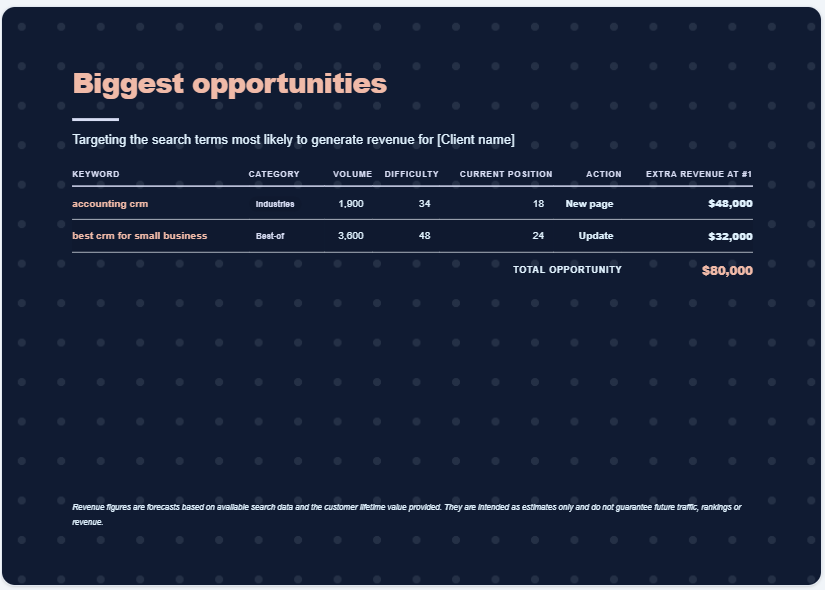
Biggest-opportunity features
- Editable keyword opportunity table
- Add Keywords and page-category fields
- Monthly search volume
- Keyword difficulty
- Current ranking position
- Recommended action
- Forecast additional revenue at position one
- Automatic total-opportunity calculation
Tips for presenting SEO opportunities
Prioritise a small number of commercially valuable opportunities that demonstrate you understand the client’s market. Include a mixture of new pages and existing-page improvements that could generate significant signups and revenue through SEO. Treat revenue figures as forecasts rather than guarantees and make the assumptions behind them clear.
Recommended strategy
Explain the work required to address the client’s current challenges and capture the opportunities you have identified.
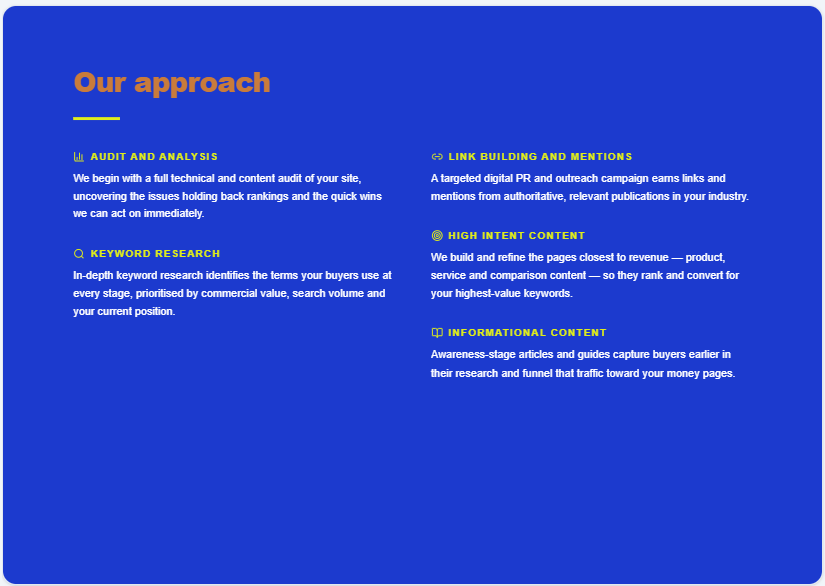
Recommended-strategy features
- Audit and analysis
- Keyword research
- Link building and brand mentions
- High-intent content
- Informational content
- Technical improvements
- Fully editable workstream headings and descriptions
- Add or remove individual strategy elements
Tips for presenting your strategy
Connect every part of the strategy to an objective or opportunity presented earlier in the proposal. Avoid including services simply because your agency offers them. The strategy should feel specifically designed for the client, with a clear explanation of how each workstream contributes to their goals.
Expected results
Set realistic expectations for how the proposed campaign could improve search visibility, and commercial outcomes.
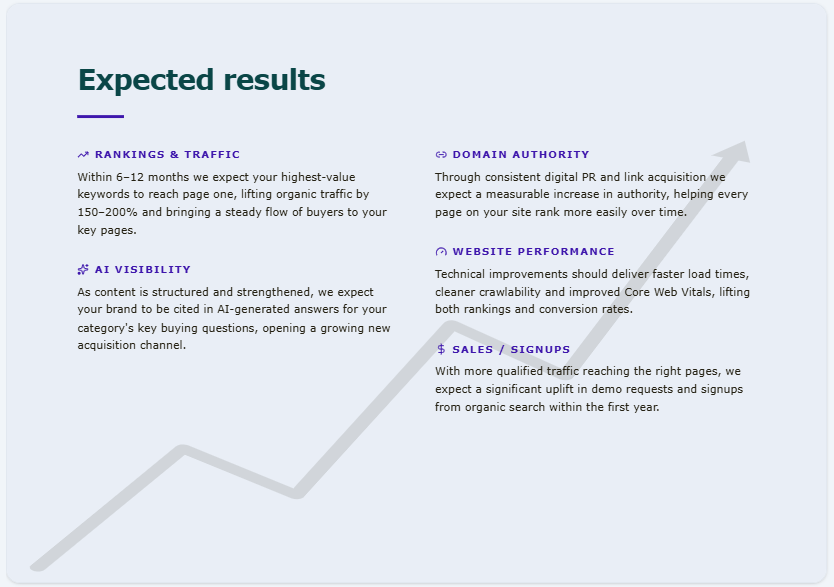
Expected-results features
- Rankings and organic traffic forecast
- AI visibility forecast
- Domain authority forecast
- Website-performance forecast
- Sales and sign-up forecast
- Fully editable forecast descriptions
- Add or remove individual result categories
Tips for describing expected results
Use realistic ranges and timeframes rather than guaranteeing specific rankings, traffic or revenue. Explain the direction and scale of the improvement you expect while making it clear that SEO performance is never guaranteed, and depends on factors such as implementation, competition and search-engine changes.
Scope and deliverables
Define exactly what the client will receive, how frequently it will be delivered and who is responsible for completing it.
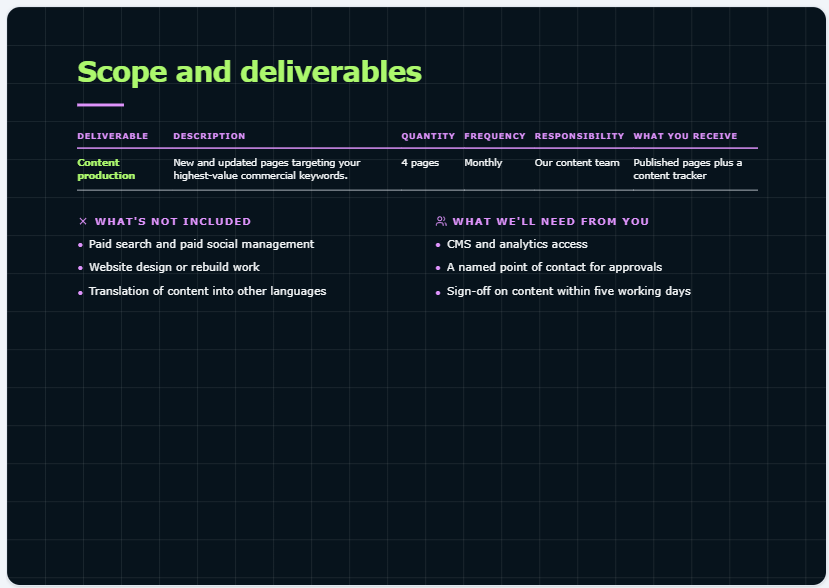
Scope and deliverables features
- Addable and removable deliverable rows
- Deliverable name and description
- Quantity
- Delivery frequency
- Responsible person or team
- Description of the finished output
- Editable list of out-of-scope services
- Editable client-responsibilities section
Tips for defining your scope
Make every deliverable specific enough that both parties understand what is included. State quantities and frequencies, and distinguish between activities your agency will provide and work the client must implement themselves. Use the exclusions and client-responsibilities sections to prevent misunderstandings later.
Timeline
Show how the proposed SEO campaign will progress and when the client can expect its key activities and deliverables.
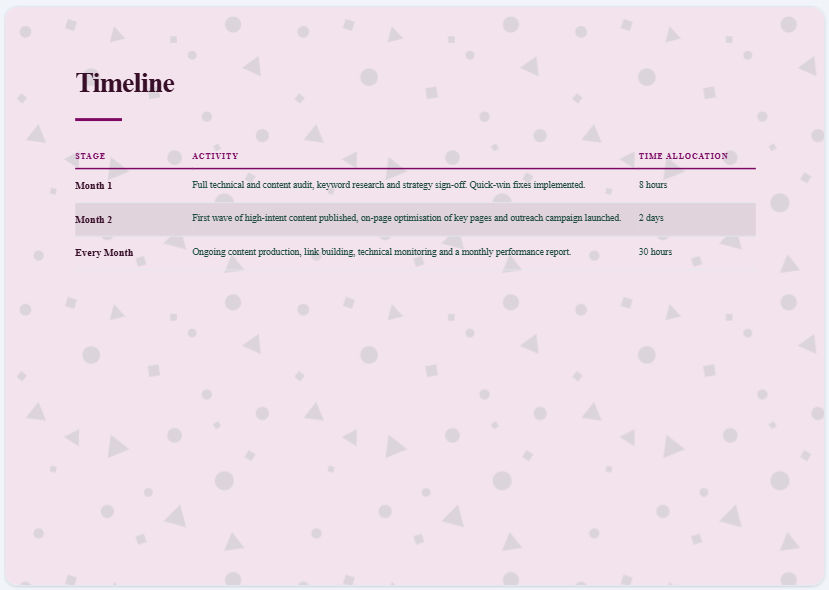
Timeline features
- Editable timeline table
- Addable and removable timeline stages
- Editable stage or period
- Activity description
- Optional time-allocation column
Tips for creating your timeline
Show the sequence of work being delivered, rather than promising exact dates that ranking or revenue will appear. Separate initial research and setup projects from recurring campaign activity, and account for client approvals or development work that could affect delivery. Keep the timeline realistic and consistent with the scope and resources included in the proposal.
Reporting and measurement
Explain how campaign performance will be tracked, communicated and connected to the client’s business objectives.
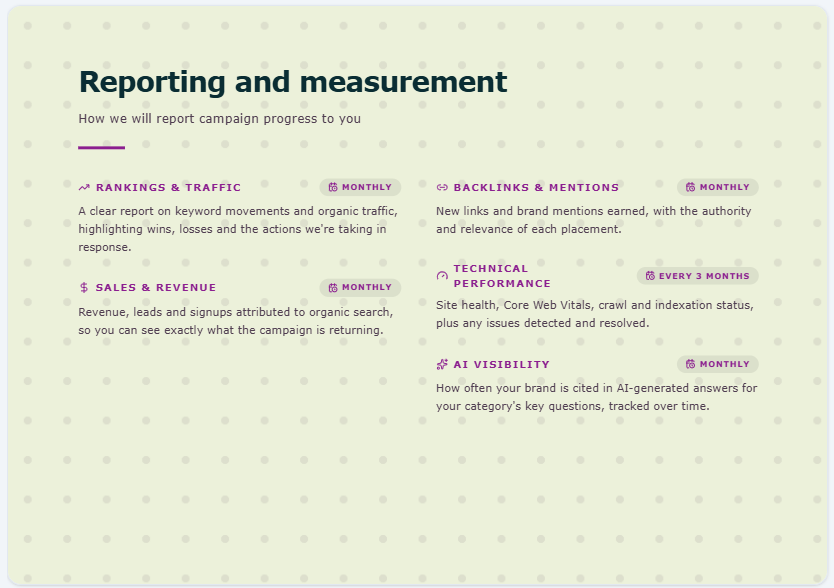
Reporting and measurement features
- Rankings and organic-traffic reporting
- Sales and revenue reporting
- Backlink and brand-mention reporting
- Technical-performance reporting
- AI visibility reporting
- Optional progress meetings
- Editable descriptions for every reporting area
- Weekly, monthly, bimonthly, quarterly, six-monthly, live or flexible reporting frequencies
- Add or remove individual reporting areas
Tips for explaining your reporting
Show the client how performance will be measured across every area of the campaign, including rankings, organic traffic, technical health, backlinks, brand mentions, AI visibility, leads, sign-ups and revenue. Each metric should reflect the work being delivered and help demonstrate progress towards the client’s wider objectives. Set a reporting frequency you can maintain consistently and explain how the findings will shape future priorities and campaign decisions.
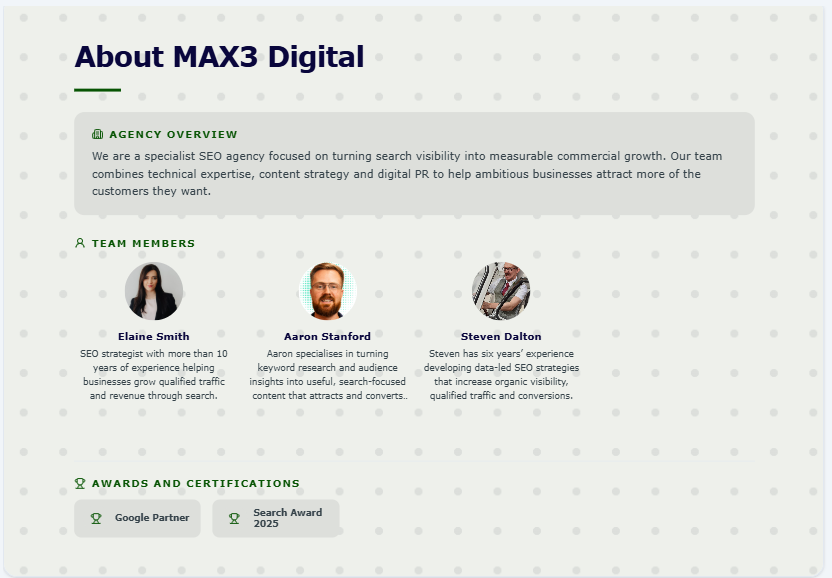
About your agency
Introduce the agency and the people who will be responsible for delivering the proposed SEO campaign.

About-us page features
- Editable agency overview
- Addable and removable team members
- Team-member names and biographies
- Team-member photograph uploads
- Addable and removable awards
- Certification names and image uploads
Tips for introducing your agency
Keep the agency overview relevant to the client’s needs rather than providing a long company history. Feature the people who will actually work on the account and highlight experience related to the client’s industry, business model or objectives. Only include awards and certifications that add genuine credibility.
Case studies
Demonstrate your ability to deliver measurable SEO results through relevant examples of previous client work.
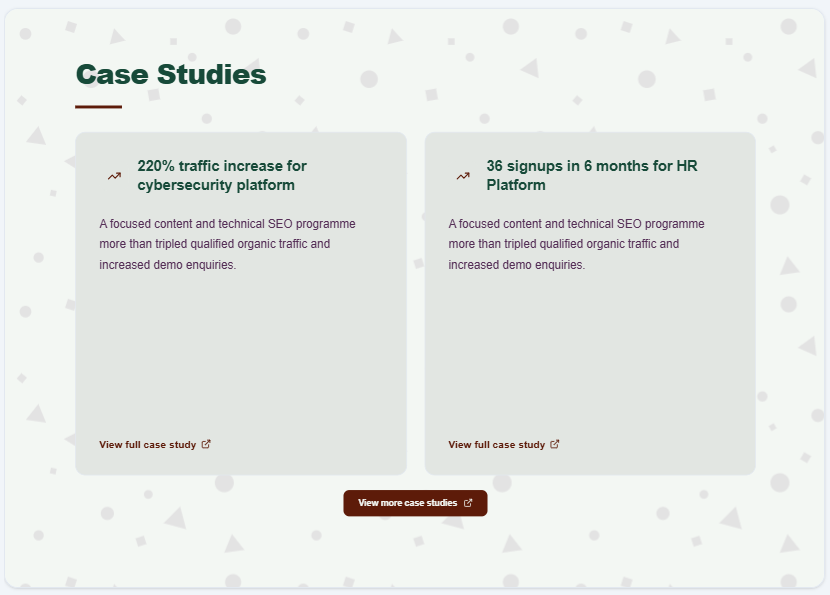
Case-study page features
- Multiple case studies
- Case-study headline
- Client name
- Client outcome description
- Optional link for each case study
- Optional “View more case studies” button and URL
Tips for choosing case studies
Select examples that closely match the prospective client’s industry, business model or SEO challenge. Lead with a specific, measurable result and briefly explain the work that produced it. One highly relevant case study will usually be more persuasive than several unrelated success stories.
Testimonials and reviews
Build trust by combining direct client feedback with ratings from recognised independent review platforms.
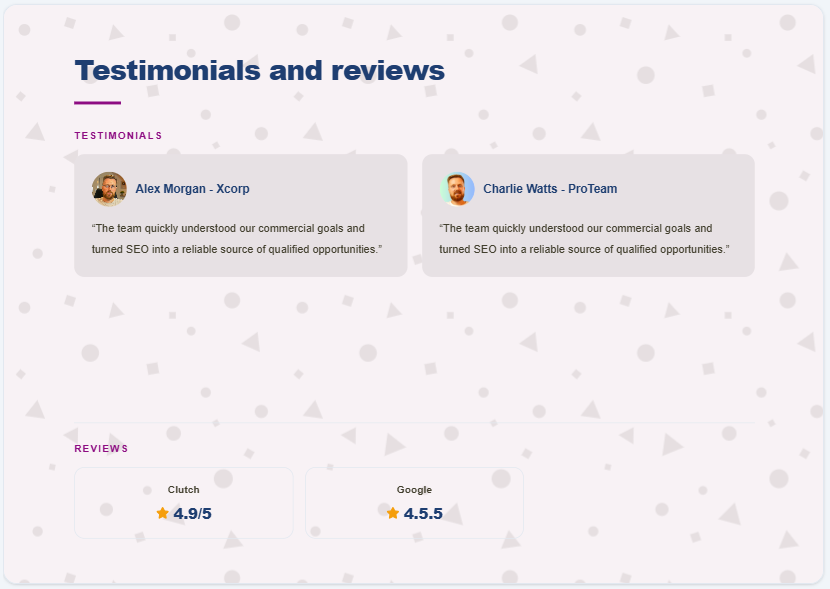
Testimonial and review features
- Multiple client testimonials
- Fully editable testimonial
- Client photograph or company-logo upload
- Multiple review-platform ratings
- Clutch, Google, G2, Trustpilot and custom platform options
- Editable review rating
- Add or remove testimonials and review platforms
Tips for adding social proof
Choose testimonials that describe a specific experience, improvement or result rather than just “these guys are good at SEO”. Include the reviewer’s real name, company and photograph or logo. Prioritise one or two strong review platforms like Clutch rather than filling the page with less meaningful badges.
Pricing
Present your proposed services, fees and payment schedule in a clear format that leaves no ambiguity about the investment required.
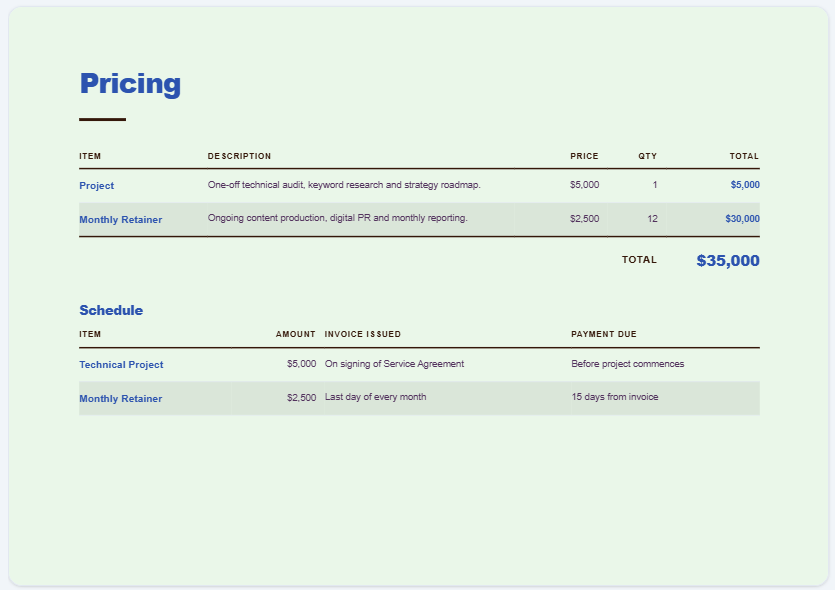
Pricing-page features
- Project and monthly-retainer pricing options
- Multiple pricing rows with Editable service descriptions
- Price and quantity fields
- Automatic line totals and proposal total
- Optional payment schedule
- Payment item and amount
- Invoice trigger and Payment due terms
Tips for presenting pricing
Make it clear what every charge covers and whether it is a one-off project fee or a recurring monthly payment. Ensure the payment schedule matches the pricing table and use triggers such as proposal acceptance, service commencement or invoice date when exact calendar dates have not yet been agreed.
Next steps
Give the client a simple, clear route for accepting the proposal and starting the engagement
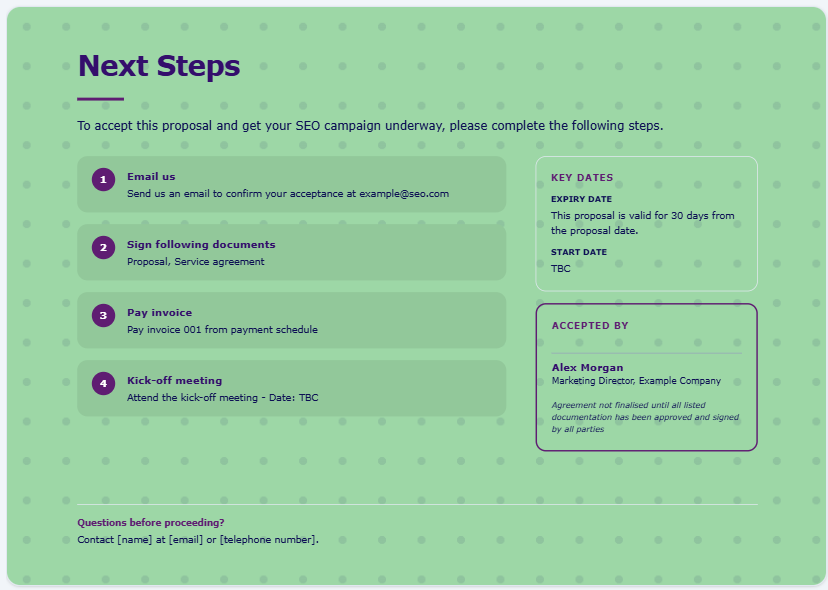
Next-steps page features
- Email-acceptance instruction
- Document-signing step
- Initial-invoice step
- Kickoff-meeting step
- Client-acceptance signature block
- Contact details for questions
- Add or remove individual next steps
Tips for creating your next steps
Only include the actions the client genuinely needs to complete, removing any steps that do not apply to your acceptance process. Make the instructions for each remaining step clear and specific, whether the client needs to reply by email, sign a service agreement, pay an invoice or attend a kickoff meeting. If the proposal is not intended to function as the complete contract, state that the engagement remains subject to the separate service agreement.
Formatting your SEO proposal template
The RevPages Proposal builder includes flexible design and layout features to help you turn detailed SEO information into a clear, professional and consistently branded proposal.
Reflect your brand with colours, fonts & more

Customise the page background, headings, subheadings and body text using your agency’s brand colours. Choose from five professional fonts and six background styles, including plain, circles, squares, triangles, mixed shapes and graph textures. You can also use the random colour-scheme generator for instant design inspiration.
Personalise the proposal with logos and images

Upload your agency logo and the client’s logo to create a proposal tailored to the pitch. You can also add a cover image, team photographs, client logos and certification images to strengthen the presentation and make your agency more recognisable.
Show performance with automatic rating scales

Score the client’s current rankings, traffic, authority, technical SEO and other performance areas from 1 to 10. The builder automatically presents each score with a clear rating label, making strengths and weaknesses easy for the client to understand at a glance.
Highlight objectives with priority labels

Assign low, medium or high priority levels to each business SEO objective. These labels help clients see which outcomes require the greatest attention and understand how you have prioritised the proposed campaign.
Present detailed info with editable tables

Use structured tables to present keyword opportunities, search data, revenue forecasts, deliverables, quantities, frequencies, responsibilities and finished outputs.
Make pricing clear with automatic totals

Add one-off projects and monthly retainers, then enter the relevant price and quantity. The builder calculates individual line totals and the overall proposal value automatically. You can also add a detailed payment schedule showing when invoices will be issued and when payment is due.
Use the SEO proposal template for a range of different pitches
Adapt the proposal builder to match your services, working style and target market. Choose the most relevant pages from the 15 available templates, then customise the content, branding, deliverables and pricing for each client and service.
SEO agency proposal template
Present your agency’s team, expertise and campaign process in a structured, professional format. Include a broad range of deliverables, explain how different specialists will contribute and set clear expectations around communication, reporting and account management.
Freelance SEO proposal template
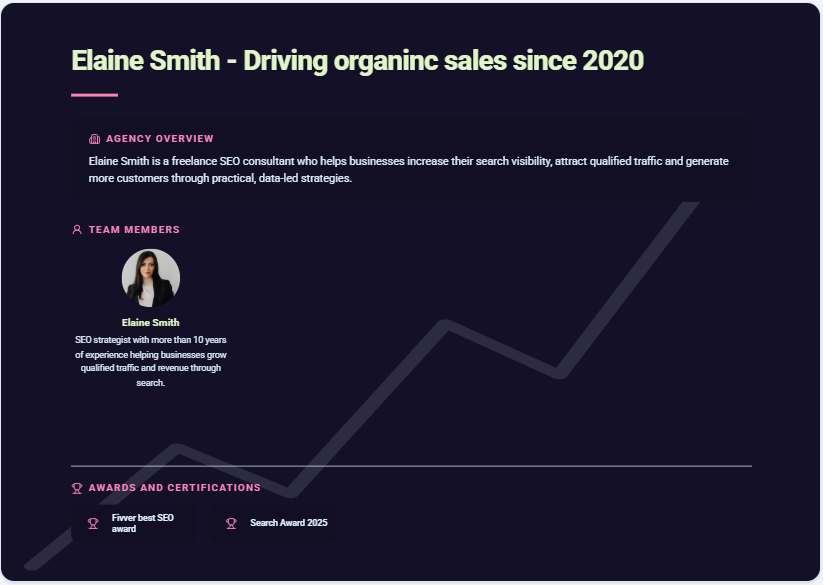
Create a shorter, more personal proposal that focuses on your individual expertise and the value of working directly with you. Highlight the client’s priorities, your recommended approach and the deliverables you will personally manage, without unnecessary agency-focused sections.
SEO content proposal template
Build a proposal centred on keyword research, content strategy, production and optimisation. Define the types and quantities of content you will deliver, explain your research and approval process, and set out how performance will be measured over time.
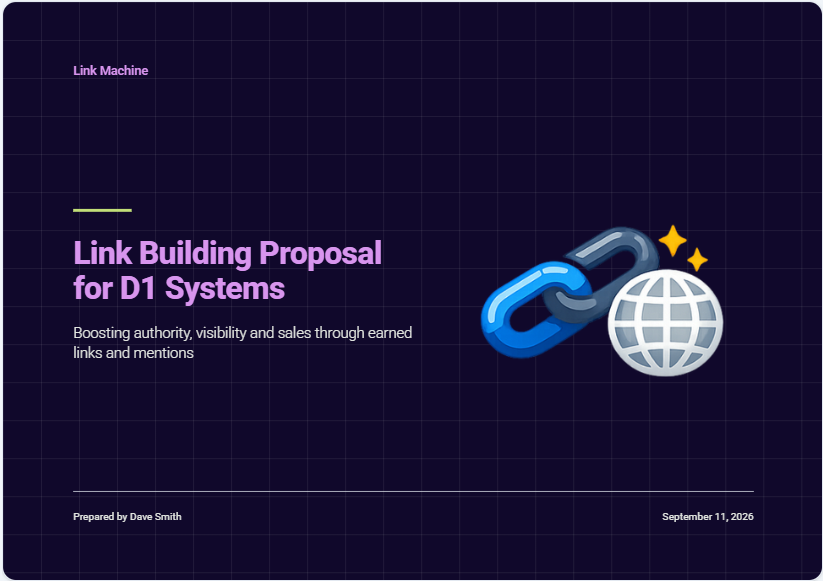
Link-building proposal template
Explain your approach to earning relevant, authoritative backlinks and improving the client’s organic visibility. Outline your link-building methods, quality standards, expected deliverables, reporting process and any exclusions, without promising specific rankings or results.
SaaS SEO proposal template
Tailor your proposal around the commercial needs of a SaaS business. Highlight high-intent keyword opportunities, product and use-case pages, competitor comparisons, revenue forecasts and measurable pipeline objectives, while connecting the proposed SEO activity to trials, demos and customer acquisition.

SEO proposal example
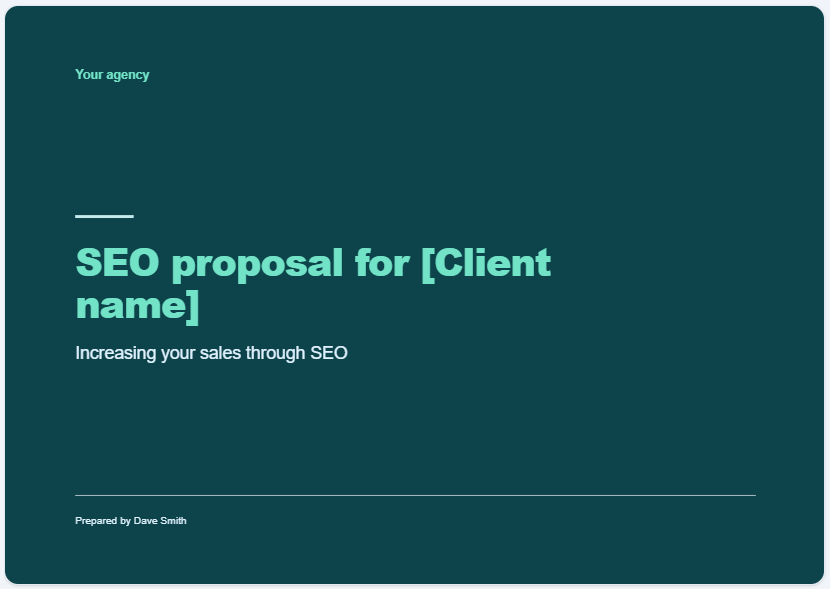
Want to see what the finished proposal looks like before creating your own? Download our free SEO proposal example to view a complete, professionally formatted PDF made with the RevPages proposal builder.
The example uses a fictional client and shows how you can present SEO objectives, current performance, keyword opportunities, strategy, deliverables, timelines, proof and pricing in one clear document. Use it for inspiration, then customise the builder with your own branding, recommendations and client information.
Download SEO proposal example.
Why use this free SEO proposal template?
Create a polished, client-specific SEO proposal without starting from scratch or paying for proposal software.
- Build complete proposals faster using professionally structured pages and pre-written SEO content.
- Avoid missing important sections covering objectives, opportunities, strategy, deliverables, timelines, proof and pricing.
- Adapt each proposal by customising the pages, content, branding, recommendations and commercial terms.
- Present your scope and pricing clearly using structured tables, editable lists, automatic calculations and payment schedules.
- Demonstrate commercial opportunities with priority keywords, search data and forecast SEO revenue potential.
- Keep complete control by editing every section, previewing the finished proposal and downloading it as a polished PDF.
- Create and download your proposal for free, with no account, subscription or payment required.
SEO proposal VS SEO contract
A proposal is not a contract – and it’s important to have both in place and know the difference between them, before commencing client work.
An SEO proposal outlines what you recommend, what work you will deliver, how long it should take and how much it will cost. Its main purpose is to help the client decide whether they want to work with you.
A contract covers the legal side of the relationship, including payment terms, confidentiality, ownership of work, liability and cancellation. While a client may sign the proposal to confirm they want to proceed, it is usually best to have a separate service agreement in place before starting work, that outlines both of your legal obligations and safeguards you both against unexpected outcomes.