
How to find profitable keywords with low competition
Discover the sweet spot between low competition and high revenue potential.
 Andrew Fennell | Last updated 10 September 2026
Key takeaways
This isn’t just a guide to finding high-CPC or low-difficulty keywords. You’ll learn how to:
- Identify profitable page types for your business
- Find low-competition commercial keywords within those page types
- Forecast the potential revenue of individual keywords
- Calculate keyword value with the free SEO revenue calculator
- Prioritise opportunities based on revenue potential and ranking difficulty
- Download the free forecasting spreadsheet to run the process yourself
The goal of SEO is simple: Rank for search terms that generate revenue.
But high-volume keywords don’t always attract buyers, while highly commercial keywords can be extremely difficult to rank for.
The sweet spot is finding profitable keywords with low enough competition to realistically rank for.
This guide shows you how to find them, forecast their revenue potential and prioritise the best opportunities – using the same process we use at RevPages.
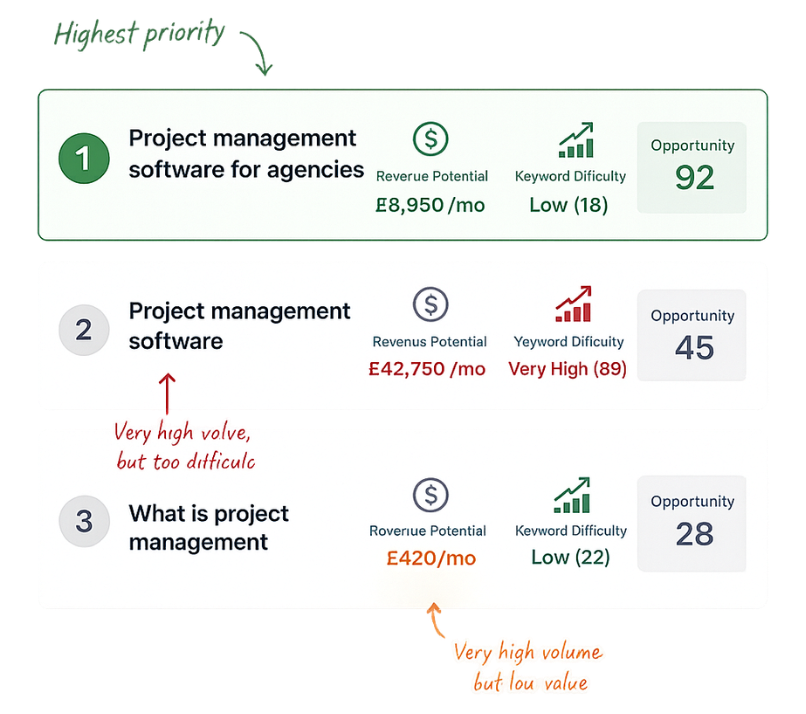
Don’t chase high-volume informational keywords
High search volume does not always equal high revenue.
Low buying intent
Many high-volume searches are informational queries, where the user is simply looking for an answer or instructions.
Searches like “how to become a project manager” or “average website speed”.
People making these searches usually aren’t looking to buy anything, so even if you attract thousands of visitors through these keywords, only a tiny percentage (<0.1%) are likely to become customers.
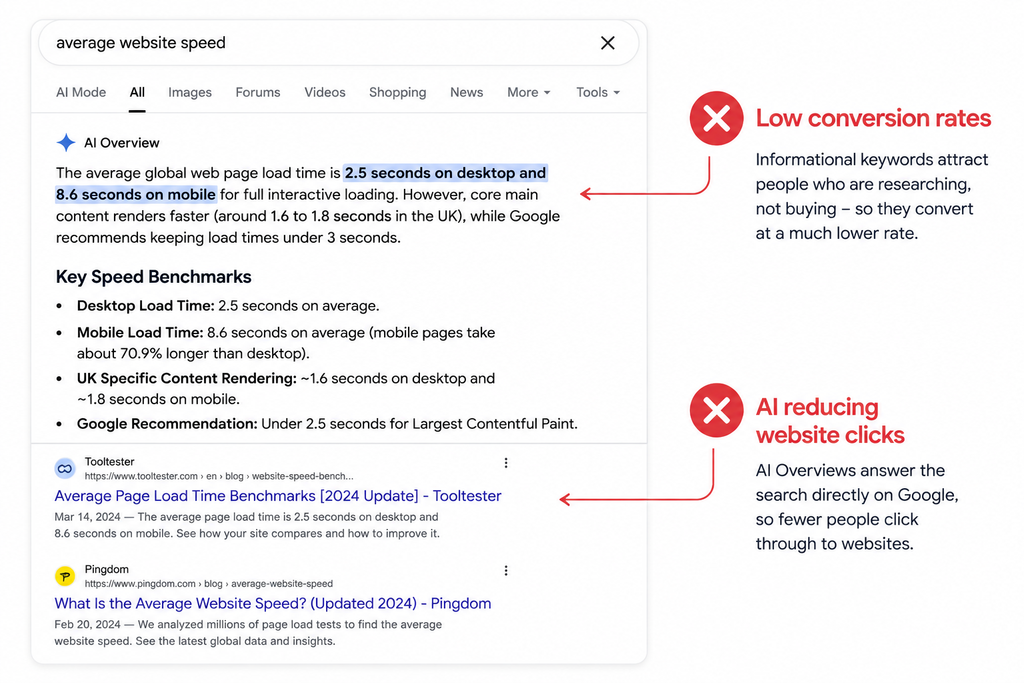
Fewer clicks
Informational searches are also generating fewer website clicks than they used to.
AI Overviews and LLMs such as ChatGPT can now answer many informational queries directly, removing the need for users to click through to a website for an answer.
The double impact
A few years ago, attracting hundreds of thousands of visitors through informational content could still be a viable strategy.
Conversion rates were low, but the sheer volume of traffic meant those pages could still generate decent revenue streams. In fact, this was part of the strategy I used when growing StandOut CV.
But the economics have changed.
Informational keywords now face two problems at once: low buying intent and fewer clicks.
That doesn’t mean informational content has no value. It can still build awareness, authority and links.
But if your primary goal is to find keywords that generate revenue, you need to start much closer to the buying decision.
Focus on lower-funnel search terms
If you want to generate revenue from SEO, focus your efforts towards the middle and bottom of the sales funnel.
These are searches where the user is actively looking to buy a product, or at least thinking about it.
For example:
- Invoice automation software
- Project management software
- Best proposal software
- CRM for legal teams
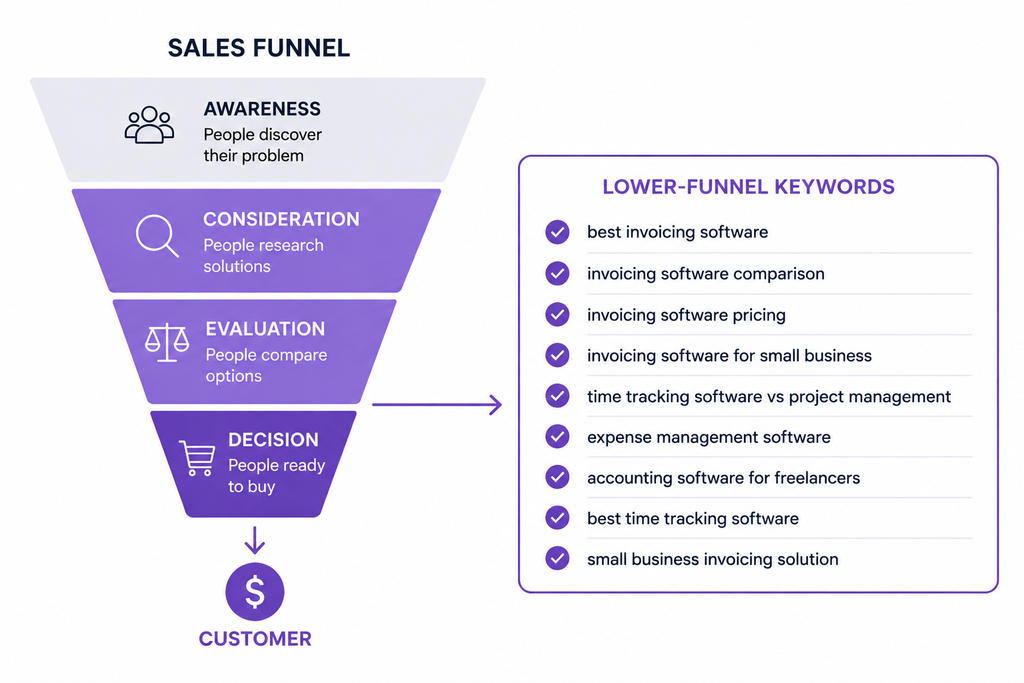
These terms may have much lower search volumes than informational queries, but they have something far more valuable: buying intent.
Someone searching for “CRM for legal teams” is much closer to becoming a customer than someone searching for “what is a CRM?”
That’s why a lower-volume commercial keyword can generate considerably more revenue than an informational keyword attracting thousands of visitors.
Here’s a simplified example:
| Informational keyword | Commercial keyword | |
| Keyword | What is a CRM? | CRM for legal teams |
| Monthly searches | 10,000 | 500 |
| Organic visits | 3,300 | 165 |
| Conversion rate | 0.1% | 5% |
| Customers | 3.3 | 8.25 |
| Customer value | £1,000 | £1,000 |
| Potential revenue | £3,300 | £8,250 |
Despite attracting 95% fewer organic visitors, the commercial keyword generates 2.5× more potential revenue.
That’s why profitable keyword research shouldn’t start with the question “Which keywords get the most searches?”
It should start with “Which searches are most likely to generate customers?”
Identify profitable page types
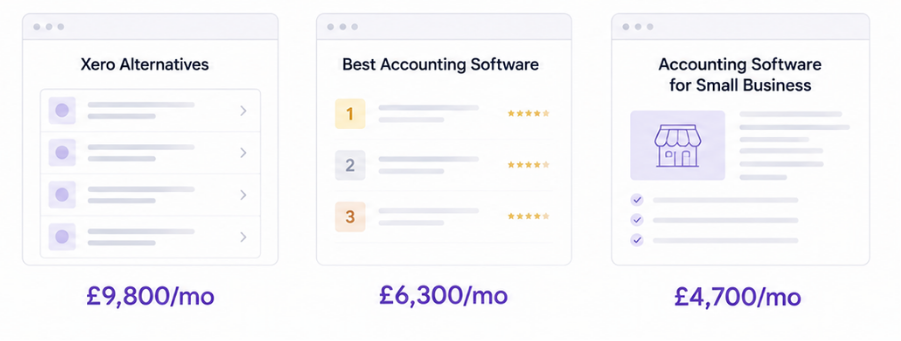
The biggest mistake people make when looking for profitable keywords is diving headfirst into an SEO tool like Ahrefs.
You’ll enter your site or a seed keyword and be presented with thousands of potential keywords – which normally leads to overwhelm and confusion.
Instead, start by identifying your profitable page types.
Every type of business has groups of pages that naturally attract people who are buying or evaluating products and services.
For example:
SaaS businesses
Service businesses
Ecommerce
These aren’t the only profitable page types, and the best ones will vary by industry.
The important thing is to identify the repeatable search patterns that occur when your potential customers are researching, comparing or looking to buy what you sell.
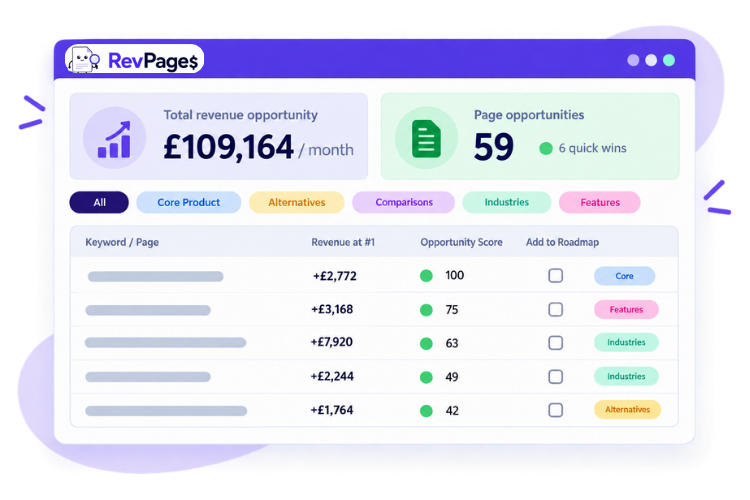
Find your most profitable keywords in 90 seconds
Revenue forecasted. Instantly prioritised by revenue-potential and ranking achievability.
There are three simple ways to work out what works in your market:
1. Study your competitors
Look at competitors that perform well in organic search and identify the commercial pages they repeatedly create.
Don’t just look at individual keywords – look for patterns in their pages.
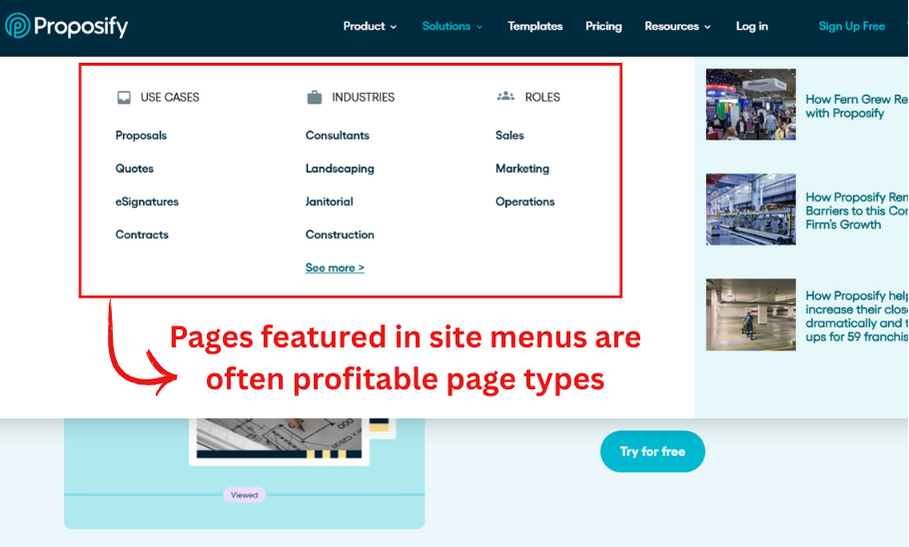
For example, you might find that several competitors have created pages for specific industries, locations, product categories, use cases or competitor comparisons.
If multiple successful competitors are targeting the same type of search, there’s a good chance it’s commercially valuable.
2. Study the SERPs
Search Google for terms that someone might use when they’re close to buying and look at the types of pages that consistently rank.
Are you seeing:
- Product or service pages?
- Category pages?
- Comparison pages?
- “Best” lists?
- Location pages?
- Industry or use-case pages?
Google’s results give you a strong indication of both what people expect to find and the type of page you’ll probably need to create to compete.
3. Study your customers
Think about the questions and considerations that come up immediately before someone buys from you.
Look at sales calls, enquiries, customer emails, support conversations and feedback.
What alternatives do customers consider? What features matter to them? Do they need a solution for a particular industry or problem? What questions do they ask before committing?
These conversations can reveal commercially valuable search patterns that aren’t immediately obvious from keyword data alone.
Starting with profitable page types cuts through thousands of irrelevant keywords and helps you focus your research on searches that are actually likely to generate revenue.
Once you’ve identified the page types that attract buyers in your industry, you can use them as a framework for brainstorming profitable keywords.
Brainstorm potential keywords
Now you have your list of profitable page types, brainstorm potential keywords for each one.
Aim for at least 10–20 ideas per category at this stage. Don’t worry too much about search volume or competition yet – you’ll validate those later.
Here’s what an initial brainstorm might look like for an accounting software SaaS business:
| Page type | Example keyword ideas |
| Core product | accounting software, online accounting software, cloud accounting software, small business accounting software, business accounting software, bookkeeping software, financial management software, business finance software, accounting platform, online bookkeeping software |
| Features / use cases | invoicing software, expense tracking software, cash flow software, bank reconciliation software, financial reporting software, accounts payable software, accounts receivable software, automated bookkeeping software, VAT accounting software, payroll and accounting software |
| Industries | accounting software for contractors, accounting software for construction, accounting software for ecommerce, accounting software for restaurants, accounting software for freelancers, accounting software for consultants, accounting software for landlords, accounting software for charities, accounting software for startups, accounting software for agencies |
| Alternatives | QuickBooks alternatives, Xero alternatives, FreshBooks alternatives, Sage alternatives, FreeAgent alternatives, Zoho Books alternatives, Wave alternatives, NetSuite alternatives, KashFlow alternatives, MYOB alternatives |
| Comparisons | QuickBooks vs Xero, Xero vs Sage, FreshBooks vs QuickBooks, Xero vs FreeAgent, Sage vs QuickBooks, Zoho Books vs QuickBooks, FreshBooks vs Xero, FreeAgent vs QuickBooks, Wave vs QuickBooks, Sage vs Xero |
| Best-of | best accounting software, best small business accounting software, best accounting software for startups, best accounting software for freelancers, best accounting software for contractors, best cloud accounting software, best bookkeeping software, best accounting software for ecommerce, best accounting software for landlords, best accounting software for agencies |
| Templates | invoice template, cash flow forecast template, profit and loss template, balance sheet template, expense report template, bookkeeping template, accounts payable template, accounts receivable template, budget template, financial statement template |
At this point, you’re generating possibilities, not choosing your final keywords. Some of these might have no search demand, some could be far too competitive and others might not be commercially relevant enough.
We’ll filter those out in the next steps.
Alternatively, you can run a free RevPages report to automatically identify all of your most profitable page opportunities and forecast their revenue in 90 seconds.
Find search volume and difficulty for keywords
Use an SEO tool like Ahrefs or SemRush to collect the monthly search volume and keyword difficulty score for each keyword in your brainstorming list.
Then add your keyword list to a spreadsheet with the following columns:
- Keyword
- Search volume
- Keyword difficulty
- Page-type

You can download my free SEO revenue forecasting spreadsheet to save time and effort.
Estimate the potential revenue of each keyword
SEO revenue calculator
This is the step that most marketers skip – and arguably the most important.
Keyword research tools often use cost-per-click (CPC) to indicate the commercial value of a keyword. But CPC tells you what advertisers are willing to pay for a click, not how much that keyword could actually be worth to your business.
Instead, estimate how much revenue a page targeting each keyword could generate per month if it reached position #1 in Google.
RevPages uses a simple SEO revenue forecasting model that you can copy:
Search volume × CTR at #1 × Page conversion rate × Customer LTV = Potential monthly revenue
Here’s how to get each figure:
- Search volume – Use the monthly search volume from your SEO tool.
- CTR at #1 – Estimate the percentage of searches that would click your result if you ranked #1. You can use the RevPages CTR model below.
- Page conversion rate – Estimate how many organic visitors the page would convert into customers. This will vary depending on the page type and search intent. You can use the RevPages conversion-rate estimates below.
- Customer LTV – Use the average lifetime value of a customer to your business.
Financial forecast assumption tables
Google position click-through rates
| Google position | Estimated CTR | Visits from 1,000 searches |
|---|---|---|
| #1 | 33% | 330 |
| #2 | 18% | 180 |
| #3 | 12% | 120 |
| #4 | 7% | 70 |
| #5 | 5% | 50 |
| #6 | 4% | 40 |
| #7 | 3% | 30 |
| #8 | 2% | 20 |
| #9 | 1.5% | 15 |
| #10 | 1% | 10 |
Page-type conversion rates
| Page type | Example keyword | Estimated conversion rate |
|---|---|---|
| Core Product | project management software | 5% |
| Competitor Alternatives | Asana alternatives | 5% |
| Competitor Comparisons | Asana vs Monday | 7% |
| Industry | project management software for agencies | 4% |
| Features | client project management software | 3% |
| Best-of Lists | best project management software | 2% |
Revenue Forecast Example
Let’s say you’re considering targeting “accounting software for contractors” – and your average customer generates £1,000 over their time with you:
500 searches per month × 33% CTR at #1 × 4% conversion rate for industry pages × £1,000 LTV
That gives you:
500 × 0.33 = 165 monthly visitors
165 × 0.04 = 6.6 customers
6.6 × £1,000 = £6,600
So, ranking #1 for this keyword could potentially generate around £6,600 in customer lifetime revenue per month.
Do this for every keyword on your list, add them to your spreadsheet and you suddenly have something much more useful than search volumes and CPCs: an estimate of the potential revenue attached to every SEO opportunity.

You’ll use this figure alongside ranking difficulty in the next step to identify the opportunities that offer the best balance of revenue potential and achievability.
You can use my free SEO revenue forecasting spreadsheet which has this model built in, or alternatively you can run a free RevPages report to instantly find all of your most valuable page opportunities and forecast their revenue automatically.
Turn hours of keyword research into 90 seconds
Automatically discover high-intent opportunities, forecast their revenue potential and see what to target first.
Look for the sweet spot: high value + low competition
Now you know the potential revenue of each keyword, you need to work out how difficult they will be to rank for.
The most profitable keyword isn’t necessarily the one with the highest revenue forecast.
If a keyword could generate £20,000 per month but would take years to reach the first page, it may be a worse opportunity than a £5,000 keyword you could realistically rank for within months.
The goal is to find the sweet spot between revenue potential and competition.
For example:
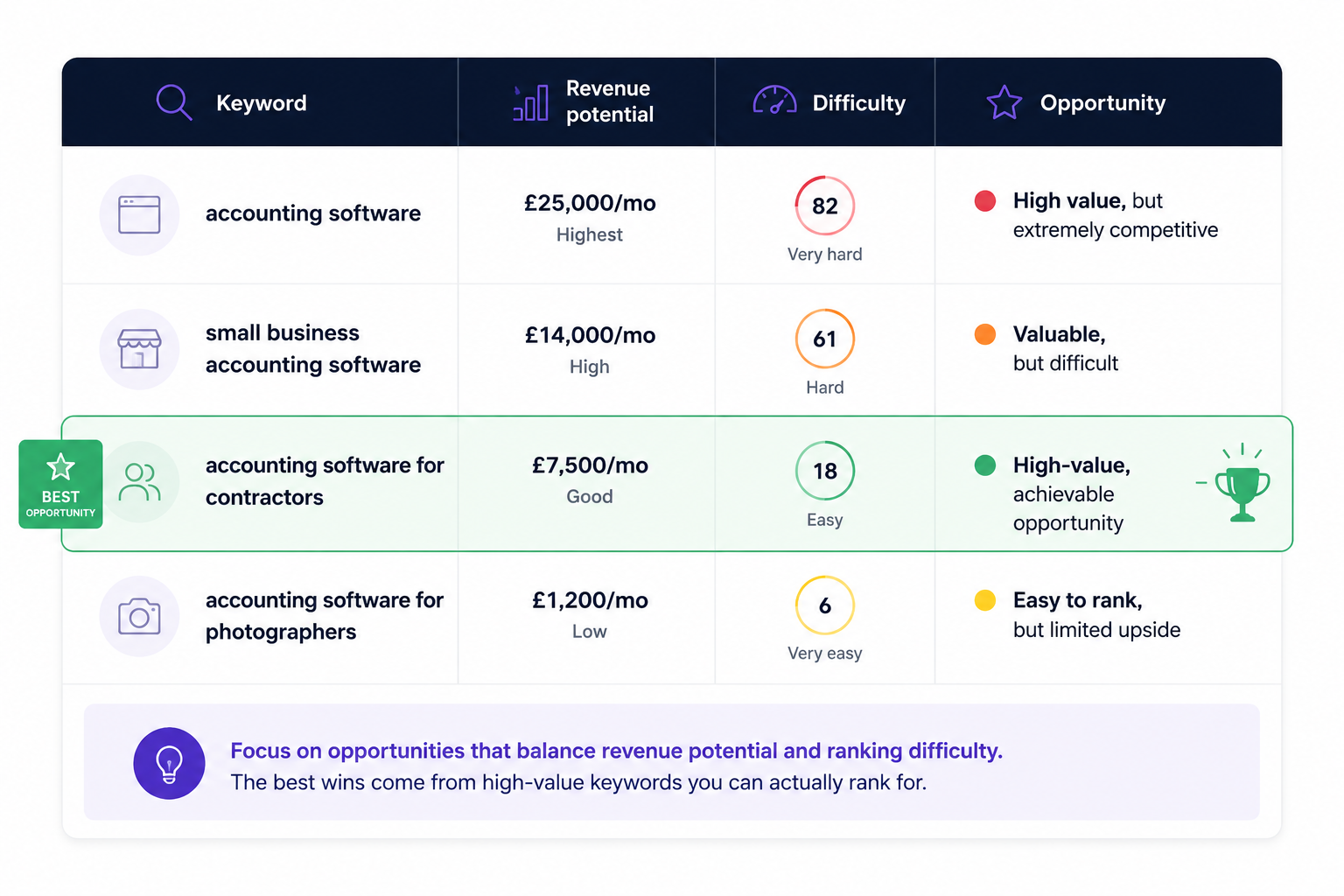
In this example, “accounting software for contractors” would probably be the best keyword to prioritise.
It doesn’t have the highest search volume or revenue potential, and it isn’t the easiest keyword to rank for.
But it offers the best combination of meaningful revenue potential and a realistic chance of ranking.
Don’t rely on keyword difficulty alone
Keyword difficulty scores from SEO tools are a useful starting point, but they shouldn’t make the decision for you.
Before targeting a keyword, look at the actual Google results.
Ask:
- Are the top results dominated by huge, authoritative websites?
- Do the ranking pages have lots of backlinks?
- Are smaller or less authoritative competitors ranking?
- Are the existing pages specifically optimised for the search?
- Could you create a substantially better or more relevant page?
- Do you already have authority around this topic?
A KD 30 keyword might be very achievable for one website and virtually impossible for another.
Ultimately, you’re looking for keywords where the potential financial return justifies the effort required to compete for them.
Those are your profitable, low-competition keywords.
RevPages does this automatically by analysing the revenue potential and ranking difficulty of every opportunity, then giving each one an SEO Revenue Opportunity score. This helps surface the keywords that offer the best balance of meaningful revenue and a realistic chance of ranking.
Check whether you already rank
Before creating a new page, check whether your website already ranks for each keyword.
An existing page at position #8 with £5,000 of potential revenue uplift could be a much quicker win than a £10,000 opportunity where you don’t rank at all.
Look for pages ranking in positions 4–20 in particular – improving an existing page can often generate results much faster than starting from scratch.
Prioritise your keywords
You should now have everything you need to decide which keywords to target first.
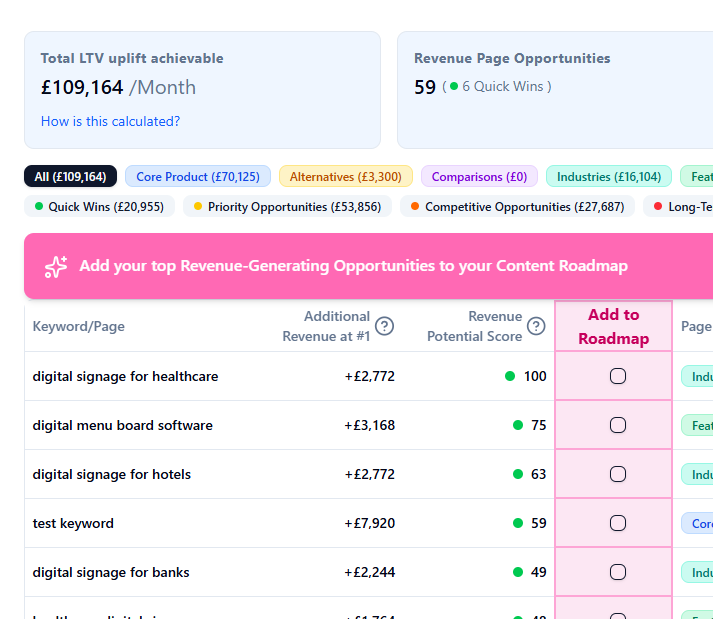
prioritised by revenue potential and achievability in RevPages
Prioritise the opportunities that combine meaningful revenue potential, low competition and achievable ranking improvements – rather than simply choosing the keywords with the highest search volumes or revenue uplift.
Start with your strongest opportunities, create or optimise the appropriate pages, then work down your list.
Find profitable keywords automatically with RevPages
You can work through this entire process manually, but researching, forecasting and prioritising dozens of keywords can take hours.
RevPages is a generative AI tool for SaaS keyword research which performs this entire process automatically — discovering commercially valuable search opportunities for your website, forecasting their potential revenue and prioritising by them rev by your likelihood of ranking.
Enter your website and customer value, and RevPages will build your prioritised SEO opportunities for you.
Discover your biggest SEO revenue opportunities in 90 seconds
Instantly prioritised by revenue potential and ranking achievability
- Don't chase high-volume informational keywords
- Focus on lower-funnel search terms
- Identify profitable page types
- Brainstorm potential keywords
- Find search volume and difficulty for keywords
- Estimate the potential revenue of each keyword
- Look for the sweet spot: high value + low competition
- Check whether you already rank
- Prioritise your keywords
- Find profitable keywords automatically with RevPages