
SEO opportunity scoring tool
Score and prioritize SEO opportunities based on their revenue uplift potential, and ranking achievability.
 Andrew Fennell | Last updated 10 September 2026
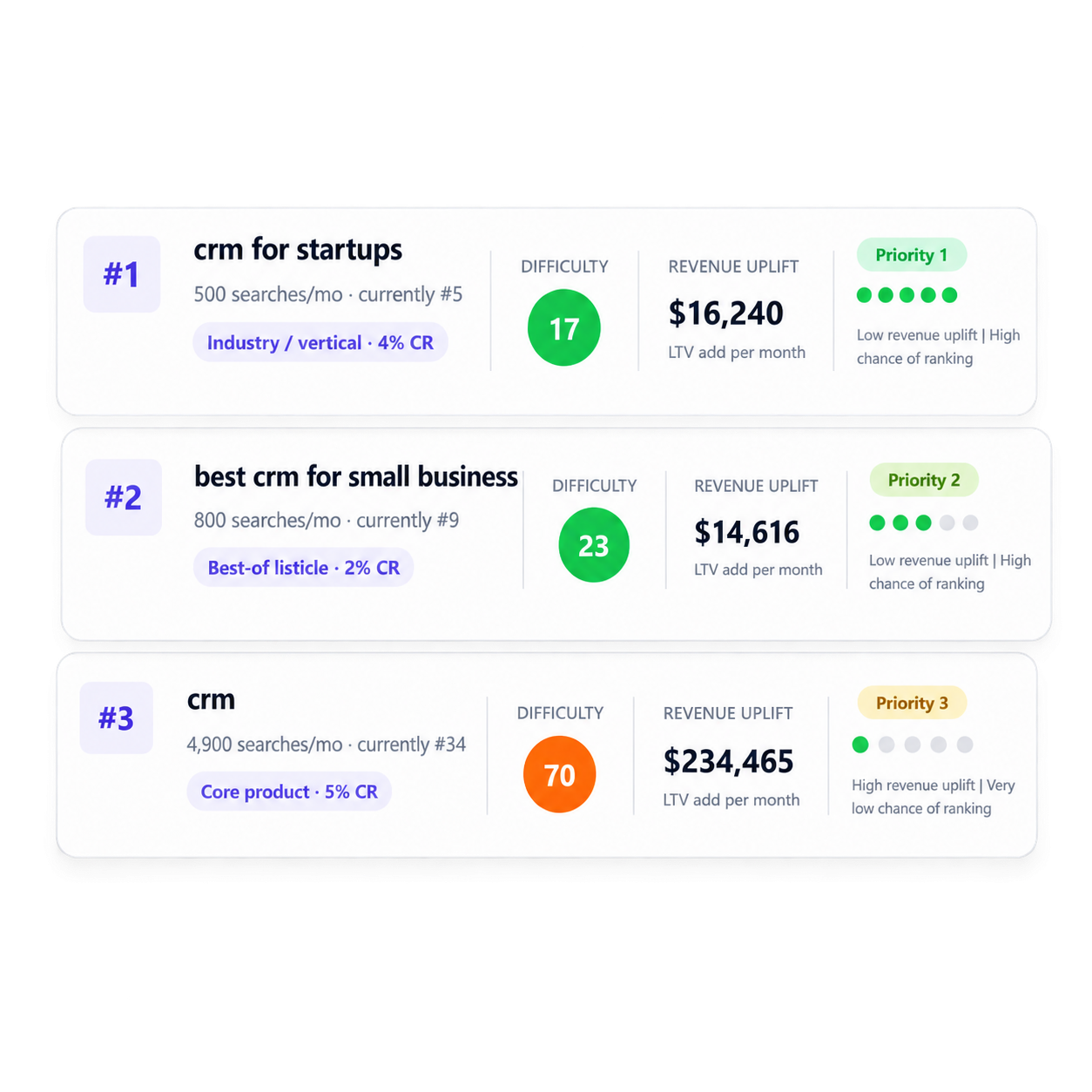
Free SEO Opportunity Scoring tool
Enter your keyword opportunities, search volumes, difficulty scores, current rankings and customer LTV. The tool will score and prioritise them based on their potential revenue uplift and ranking achievability.

How the SEO opportunity scoring tool works
The SEO Opportunity Scoring Tool helps you compare up to five keyword or page opportunities and identify which one you should prioritise.
For each opportunity, enter:
- Keyword – The search term you want to target
- Monthly search volume – The estimated number of monthly searches
- Keyword difficulty – An estimate of how competitive the search results are
- Current Google position – Where your website currently ranks for the term
- Page type – Such as a product, comparison, alternative or informational page
- Customer lifetime value – The average revenue generated by a customer
The tool uses this data to evaluate three important factors:
1.Revenue potential
Search volume alone cannot tell you how valuable a keyword is. The tool estimates the potential revenue of each opportunity using its search demand, likely click-through rate, expected conversion rate for the page-type and your customer lifetime value.
This helps distinguish commercially valuable keywords from high-volume searches that are unlikely to generate customers.
2 .Ranking achievability
A valuable keyword is only worth pursuing if you have a realistic chance of ranking for it.
The tool considers keyword difficulty to estimate how achievable each opportunity is. More competitive keywords may still be worthwhile, but they will generally require more time, stronger content and greater website authority.
3. Available ranking uplift
Your current Google position affects how much untapped potential remains.
A keyword ranking in position six may represent a valuable quick win, while one already ranking first offers no additional upside. Keywords that do not rank at all can offer substantial growth, but may require more work than improving an existing page.
Your SEO Opportunity Score
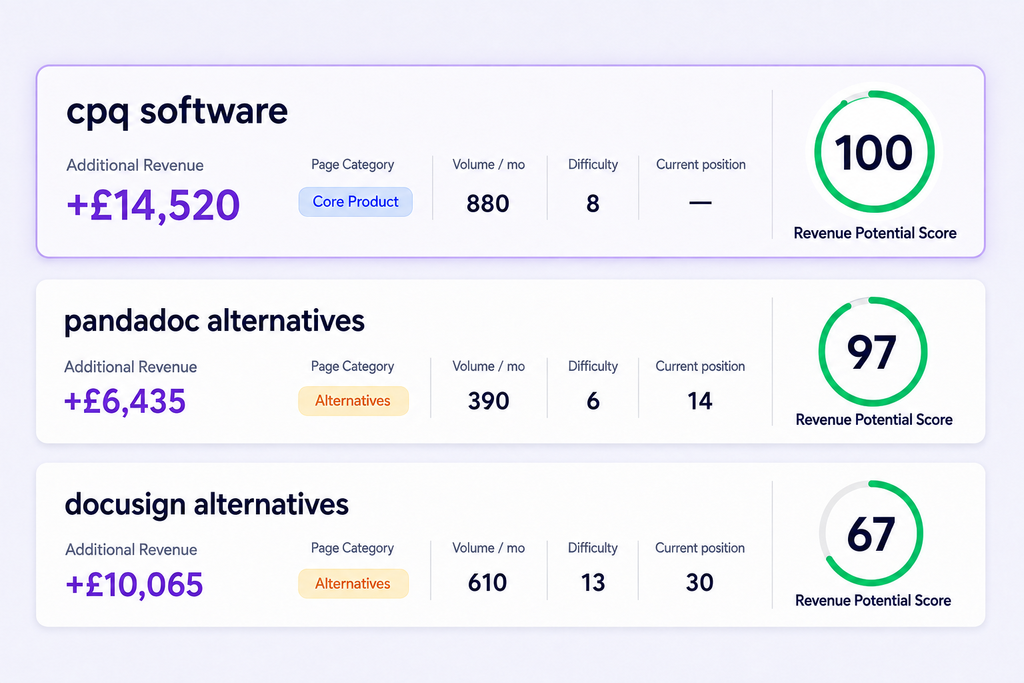
The tool combines these factors to produce an SEO Opportunity Score from 0 to 100 for each keyword.
A higher score indicates a stronger combination of:
Your opportunities are then ranked from highest to lowest priority, helping you decide which page to create or optimise first.
The score should be used as a prioritisation guide rather than a guarantee of rankings or revenue. It provides a consistent way to compare opportunities using the same criteria, instead of relying on search volume, keyword difficulty or instinct alone.
Discover your biggest SEO revenue opportunities in 90 seconds
Instantly prioritised by revenue potential and ranking achievability
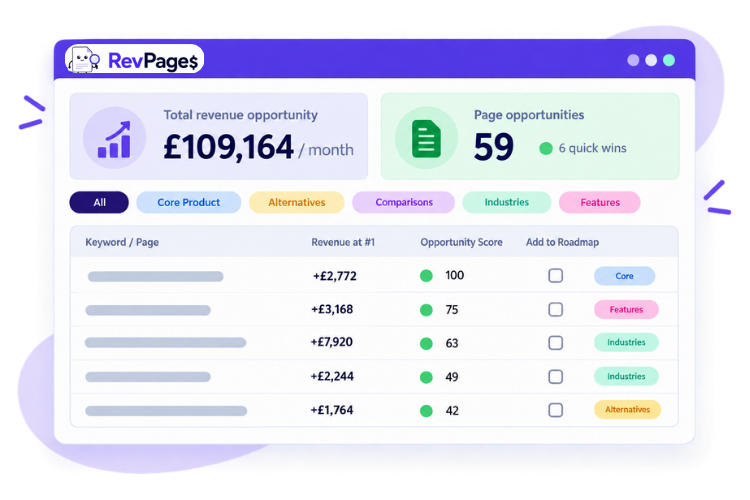
What Is SEO Opportunity Scoring?
SEO opportunity scoring is the process of assigning a numerical score to keywords or potential pages so they can be compared and prioritised.
Rather than choosing targets based on search volume alone, opportunity scoring considers several factors that determine whether an SEO opportunity is genuinely worth pursuing:
- Revenue potential - How much revenue the page could generate
- Ranking achievability - How realistic it is to compete for the target keyword
- Current position - Whether your website already ranks for the keyword
- Available uplift - How much additional traffic and revenue could be gained
These factors are combined into a single SEO Opportunity Score, usually measured from 0 to 100. The higher the score, the stronger the balance between potential commercial value and the likelihood of achieving it.
This gives marketers a consistent way to answer an important question:
Which SEO opportunity should we work on next?
Without an opportunity scoring system, teams often prioritise keywords with the highest search volumes or lowest difficulty scores. But a low-difficulty keyword may generate little business value, while a high-volume informational keyword may attract plenty of visitors without producing customers.
SEO opportunity scoring helps you identify profitable keywords that are not merely capable of generating traffic, but have a realistic chance of generating revenue.
How to score SEO opportunities
Here’s how to score your own SEO opportunities based on their potential revenue uplift and ranking achievability, using the RevPages methodology.
1. Estimate the revenue at position one
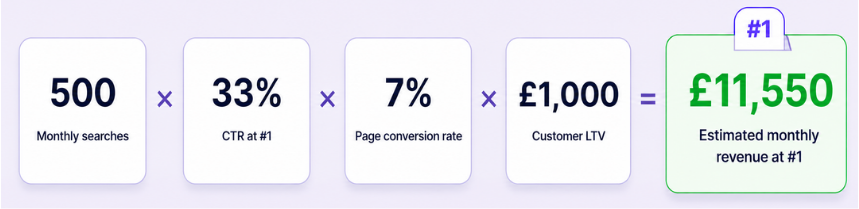
First, estimate how much monthly revenue the page could generate if it reached position #1 in Google - using our simple SEO revenue forecasting model:
Monthly search volume × CTR at position one × page conversion rate × customer LTV
RevPages uses an estimated organic click-through rate of 33% at position one and applies different conversion rates according to the page type:
| Page type | Example keyword | Estimated conversion rate |
|---|---|---|
| Core Product | project management software | 5% |
| Competitor Alternatives | Asana alternatives | 5% |
| Competitor Comparisons | Asana vs Monday | 7% |
| Industry | project management software for agencies | 4% |
| Features | client project management software | 3% |
| Best-of Lists | best project management software | 2% |
RevPages focuses on commercial page-types that are designed to drive revenue - and doesn’t include informational content such as general guides and blog posts.
For example, consider a comparison keyword with:
- 500 monthly searches
- A 7% estimated conversion rate
- A customer LTV of £1,000
Its estimated monthly revenue at position one would be:
500 × 33% × 7% × £1,000 = £11,550
You can create a spreadsheet and add a formula to carry our these calculations - or you can just grab a copy of my free SEO revenue forecasting spreadsheet.
2. Calculate the available revenue uplift
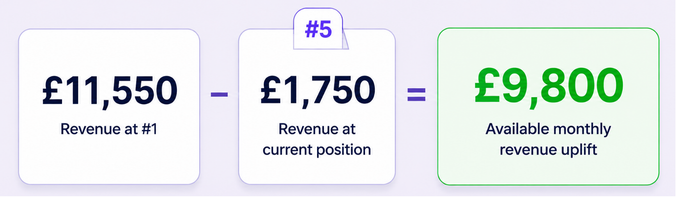
If your website already ranks for the keyword, some of its potential revenue will already be captured.
RevPages estimates the revenue generated at the current position and subtracts it from the potential revenue at position one, using the following organic click-through rate estimates compiled from a range of industry studies:
| Google position | Estimated CTR | Visits from 1,000 searches |
|---|---|---|
| #1 | 33% | 330 |
| #2 | 18% | 180 |
| #3 | 12% | 120 |
| #4 | 7% | 70 |
| #5 | 5% | 50 |
| #6 | 4% | 40 |
| #7 | 3% | 30 |
| #8 | 2% | 20 |
| #9 | 1.5% | 15 |
| #10 | 1% | 10 |
Revenue at position one − estimated revenue at the current position = revenue uplift
For example, if the page currently ranks in position five, RevPages applies an estimated CTR of 5%:
500 × 5% × 7% × £1,000 = £1,750
The estimated additional revenue available would therefore be:
£11,550 − £1,750 = £9,800 per month
If the website does not currently rank in the top 10, the full estimated revenue at position one is treated as available uplift.
3. Apply a current ranking multiplier
The current Google position affects the achievability of the opportunity.
A page already ranking between positions four and twenty may be easier to move into a high-value position than a page ranking beyond the top 50 - or creating a new page from scratch. However, pages already occupying the top three positions have much less remaining upside.
RevPages applies the following multiplier to account for this:
| Current Google position | Ranking multiplier |
| Not currently ranking | 1.0 |
| Positions 1–3 | 0.2 |
| Positions 4–10 | 1.5 |
| Positions 11–20 | 2.0 |
| Positions 21–50 | 1.2 |
| Position 50+ | 1.0 |
This gives greater weight to existing pages sitting within striking distance of the highest-value positions - whilst recognising the limited upside to pages which already rank highly.
4. Calculate the difficulty factor
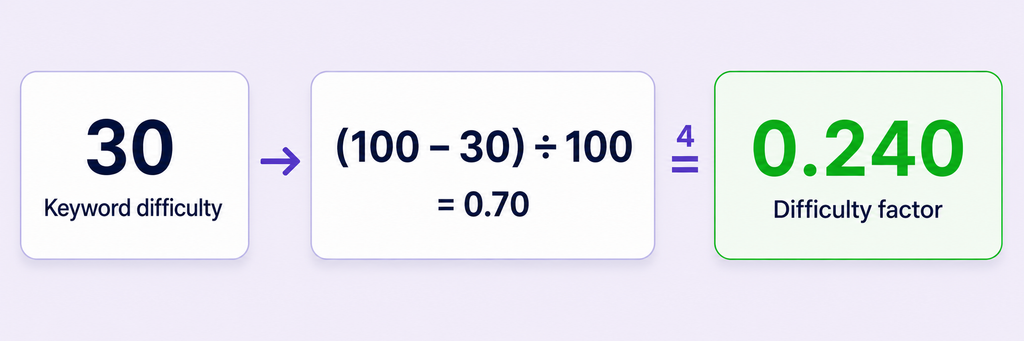
RevPages uses keyword difficulty to estimate how realistic it will be to compete for the target keyword.
Rather than reducing the score in a straight line, it uses a non-linear calculation:
Difficulty factor = ((100 − keyword difficulty) ÷ 100)⁴
This means that the difficulty penalty becomes progressively stronger as the keyword difficulty increases - reflecting the increased effort required to rank for mega-competitive keywords.
Additional reductions are applied at the highest difficulty levels:
- For KD scores from 60 to 69, the factor is multiplied by 0.5
- For KD scores of 70 or higher, the factor is multiplied by 0.3
This produces approximate difficulty factors such as:
| Keyword difficulty | Difficulty factor |
| 10 | 0.656 |
| 30 | 0.240 |
| 50 | 0.0625 |
| 60 | 0.013 |
| 70 | 0.0024 |
| 80 | 0.00048 |
Difficulty therefore acts as a strong dampener. A high-revenue keyword with a KD of 70 may receive a lower overall score than a more modest but much more achievable opportunity.
Turn hours of keyword research into 90 seconds
Automatically discover high-intent opportunities, forecast their revenue potential and see what to target first.
5. Calculate the raw opportunity score
The revenue uplift, ranking multiplier and difficulty factor are then combined:
Raw score = revenue uplift × ranking multiplier × difficulty factor
For example, suppose an opportunity has:
- £9,800 estimated monthly revenue uplift
- A current position of five, giving it a 1.5 ranking multiplier
- A keyword difficulty of 30, giving it a 0.24 difficulty factor
Its raw score would be:
£9,800 × 1.5 × 0.24 = 3,528
The raw score is not shown as the final result. It is used to compare the opportunity with every other keyword in the report.
6. Protect the results from extreme outliers
Some keywords have unusually large search volumes or revenue forecasts that could dominate the entire report, even when they would be extremely difficult to rank for.
RevPages treats a keyword as an outlier when it:
- Accounts for more than 30% of the report’s total estimated revenue uplift; and
- Has more than three times the revenue uplift of the next-highest keyword
When both conditions are met, RevPages recalculates its difficulty factor using an exponent of eight instead of four:
Outlier difficulty factor = ((100 − keyword difficulty) ÷ 100)⁸
This applies a much steeper difficulty penalty and prevents one enormous but potentially unrealistic keyword from distorting the priorities across the report.
7. Convert the results into scores from 0 to 100

Finally, RevPages compares every raw score with the highest raw score in the report:
SEO Opportunity Score = raw score ÷ highest raw score × 100
The strongest opportunity receives a score of 100. Every other opportunity is scored relative to it.
A high score therefore indicates a strong combination of:
- Significant potential revenue
- Substantial available revenue uplift
- A useful existing Google position
- Relatively low ranking difficulty
Because the scores are normalised within each report, they are designed for comparing opportunities on the same website. A score of 80 in one report is not necessarily equivalent to a score of 80 in another.
The result is a commercially focused priority order showing which SEO pages are most likely to deliver worthwhile, achievable revenue growth.
SEO Opportunity Scoring Example
Suppose a software company is comparing three potential SEO opportunities:
| SEO opportunity | Revenue uplift | Current position | Difficulty | Opportunity score |
|---|---|---|---|---|
| Software A vs Software B | £9,800 | 5 | 30 | 100 |
| Invoice automation guide | £3,000 | 12 | 20 | 70 |
| Accounting software for agencies | £15,000 | Not ranking | 50 | 27 |
Although “accounting software for agencies” has the greatest revenue potential, its higher difficulty and lack of an existing ranking make it less achievable.
The comparison page receives the highest score because it combines strong revenue potential, moderate difficulty and an existing first-page ranking—making it the best opportunity to prioritise.
SEO Prioritisation Framework
Your SEO Opportunity Scores provide an initial priority order based on revenue uplift, ranking achievability and existing performance.
The next step is to turn those scores into an actionable SEO roadmap. Before committing resources, use these four questions as a final sense check:
| Factor | Question |
| Business value | Would achieving this opportunity make a meaningful commercial difference? |
| Search demand | Is there sufficient demand to justify creating or optimising the page? |
| Ranking achievability | Can you realistically compete with the current search results? |
| Strategic fit | Does the opportunity support your product, customers and wider SEO strategy? |
You can then group your opportunities into four priorities:
- High value + highly achievable: Prioritise immediately
- High value + difficult: Treat as a strategic, longer-term investment
- Low value + highly achievable: Pursue when capacity allows
- Low value + difficult: Usually ignore
The score provides the data-led starting point. The framework adds the commercial and strategic judgement needed to decide what enters your roadmap - and when.
Why Traditional SEO Prioritisation Methods Fall Short
SEO opportunities are often prioritised using a single metric, such as search volume or keyword difficulty. While these metrics are useful, none provides a complete picture of an opportunity’s commercial potential.
Effective SEO prioritisation requires these signals to be considered together. RevPages combines potential revenue, ranking difficulty and current performance to identify the opportunities most likely to deliver achievable revenue growth.
How much SEO revenue are you leaving on the table?
RevPages uncovers your biggest opportunities and shows you which ones are most valuable... and achievable.
Score Your Entire Website with RevPages
If you want to save hours of keyword research and manual scoring, RevPages can analyse and prioritise the SEO opportunities across your entire website automatically.
Enter your website and customer LTV, and RevPages will:
- Discover a focused list of commercially valuable page opportunities
- Forecast the potential revenue uplift of each one
- Assess ranking difficulty and current performance
- Score and prioritise every opportunity
- Turn your highest-priority pages into an actionable SEO roadmap
- Create AI generated content briefs for every page
- Track the performance and revenue of your existing pages
In around 90 seconds, you’ll see which pages offer the strongest combination of revenue potential and ranking achievability.
Discover your highest-value SEO Opportunities