
7 Best Generative AI Tools for SaaS Keyword Research
Tried and tested by an exited SaaS founder
 Andrew Fennell | Last updated 15 September 2026
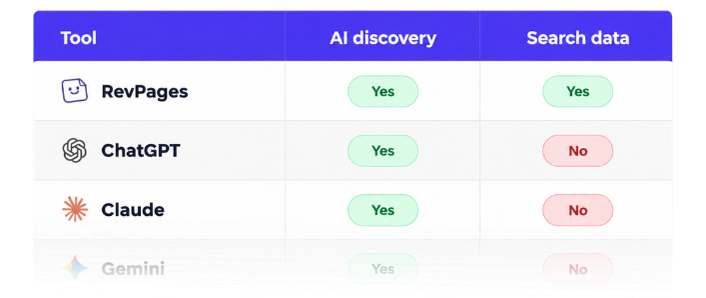
Generative AI has made SaaS keyword research significantly faster, but if you do it regularly, you’re probably still looking for ways to speed up the process.
Tools such as ChatGPT and Claude can analyse a website and generate hundreds of relevant keyword ideas in a matter of minutes.
But, what they can’t do reliably is tell you how many people search for those terms, how difficult they will be to rank for or whether targeting them is likely to generate revenue.
I’ve done countless hours of keyword research to grow my own SaaS business (StandOut CV) and generate millions of organic visits, as well as developing SEO strategies for SaaS clients.
In my experience, the most effective process combines the speed and analytical capabilities of generative AI with accurate keyword, competitor and ranking data.
These are the seven generative AI tools I would consider for SaaS keyword research.
The best AI tools for SaaS keyword research – Quick Comparison
| Tool | Best for | AI keyword discovery | Reliable search data |
|---|---|---|---|
 RevPages | End-to-end, revenue-focused SaaS keyword research | Yes | Yes |
| ChatGPT | Generating initial keyword and content ideas | Yes | No |
| Claude | Analysing customer and product information | Yes | No |
| Gemini | AI research within the Google ecosystem | Yes | No |
| Perplexity | Source-backed market and competitor research | Yes | No |
| Semrush | Validating AI-generated ideas with search data | Limited | Yes |
| Ahrefs | Validating demand and assessing ranking opportunities | Limited | Yes |
1. RevPages
Best for: Finding and prioritising revenue-focused SaaS keyword opportunities
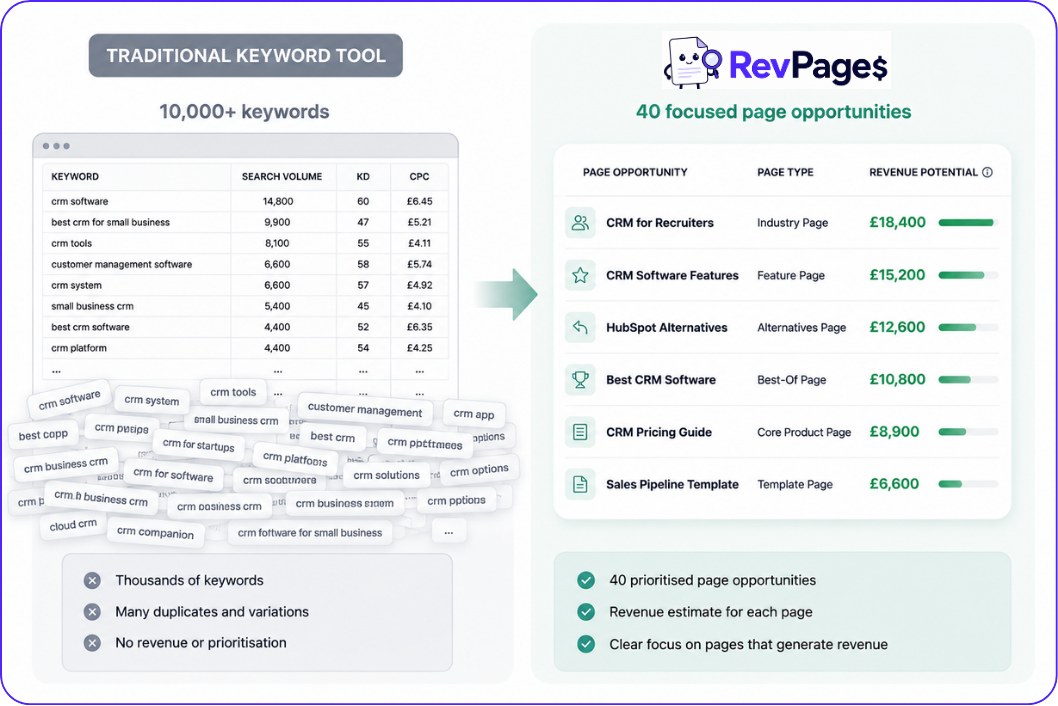
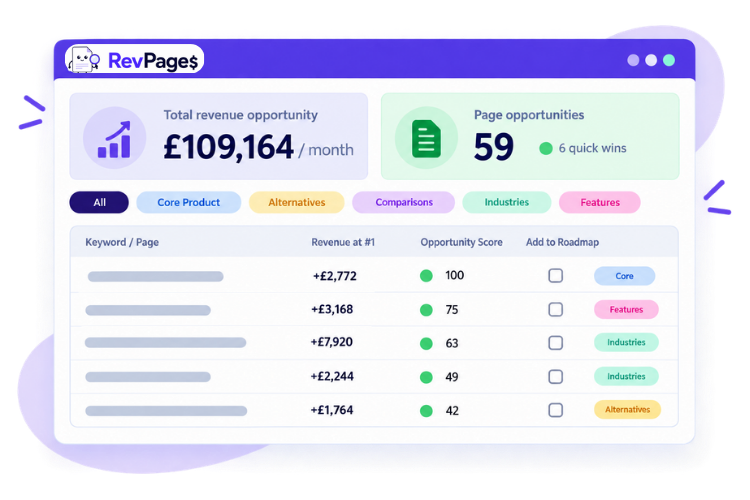
RevPages finds a SaaS website’s best revenue-generating keywords, and forecasts their potential revenue uplift.
I built RevPages because I was frustrated with how fragmented and long-winded SaaS keyword research had become.
When preparing an SEO strategy for a SaaS company, I would normally need to analyse its website, understand the product, generate possible keyword ideas, check each term in an SEO tool, review current rankings and then use a spreadsheet and formulas to estimate which opportunities might produce revenue.
It was a useful process to show clients the revenue potential behind keywords, but it was also extremely time-consuming.
RevPages brings all of those steps together in just under 2 minutes.
How it works
You enter a SaaS website, customer lifetime value and target market, and the platform uses AI to analyse the product and identify potentially valuable page opportunities for SEO.
These include:
- Competitor alternative pages
- Product comparison pages
- Industry landing pages
- Feature and use-case pages
- “Best software” searches
- Templates and other useful resources
- Core product-category keywords
RevPages then combines those ideas with real search-volume, keyword-difficulty and ranking data. It also estimates the potential monthly revenue available from each opportunity and prioritises the results according to their commercial value and achievability.
That combination is important. A general generative AI tool can suggest that a particular keyword sounds relevant, but it cannot reliably tell you whether anybody searches for it or whether your website already ranks in a position that could be improved.
Who’s it for?
RevPages is best suited to SaaS founders, in-house marketing teams and SEO agencies that want to move from broad keyword suggestions to a prioritised plan of commercially valuable pages.
Its biggest difference from the general AI tools on this list is that it has been designed specifically for SaaS keyword research rather than being adapted to it through prompting.
Example RevPages Keyword Discovery: GetAccept
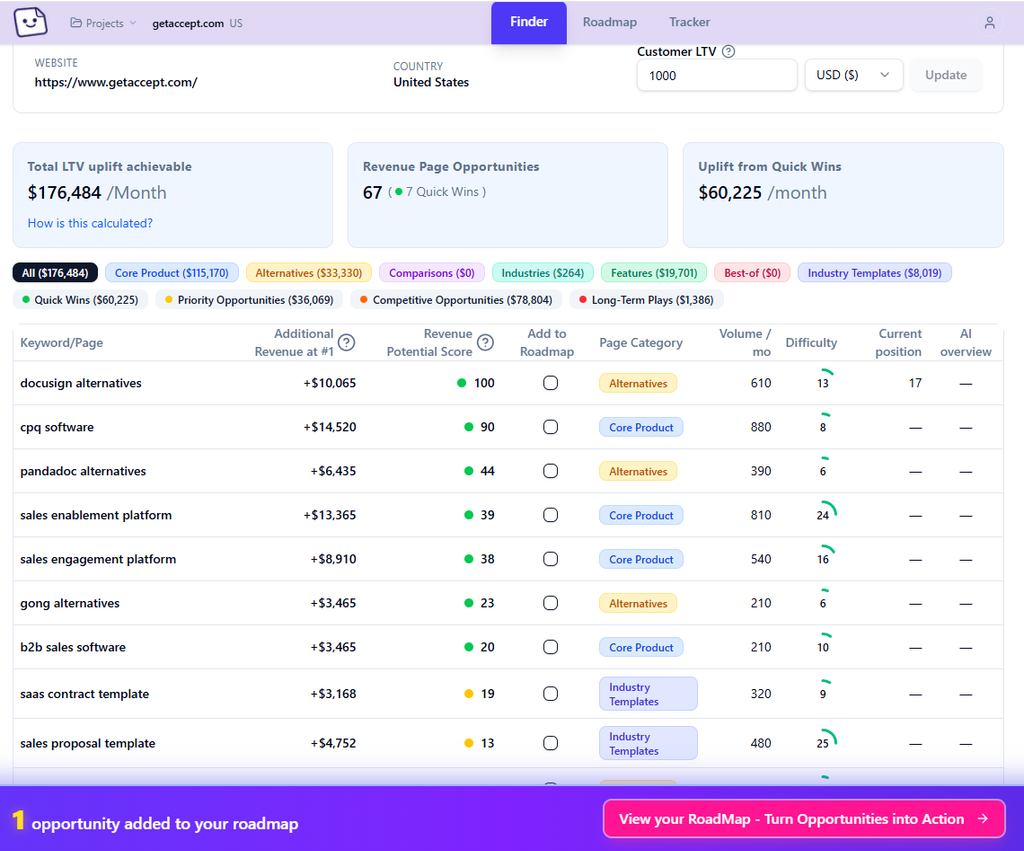
I ran Proposal Software tool, GetAccept through RevPages using its website, the US market and an estimated customer LTV of $1,000 (just a random guess). It found 67 potential revenue pages, including seven quick wins, with a combined estimated monthly LTV uplift of $176,484.
Crucially, RevPages doesn’t simply prioritise the keywords with the highest potential revenue. For example, it ranked “PandaDoc alternatives”, with an estimated uplift of $6,435, above “sales enablement platform”, worth an estimated $13,365. That is because “PandaDoc alternatives” has a much lower difficulty score of six, compared with 24, making the lower-value term a more achievable opportunity.
Enter a SaaS website into RevPages to find it’s most valuable SEO opportunities and forecast their revenue in 90 seconds.
2. ChatGPT
Best for: Generating an initial list of SaaS keyword ideas
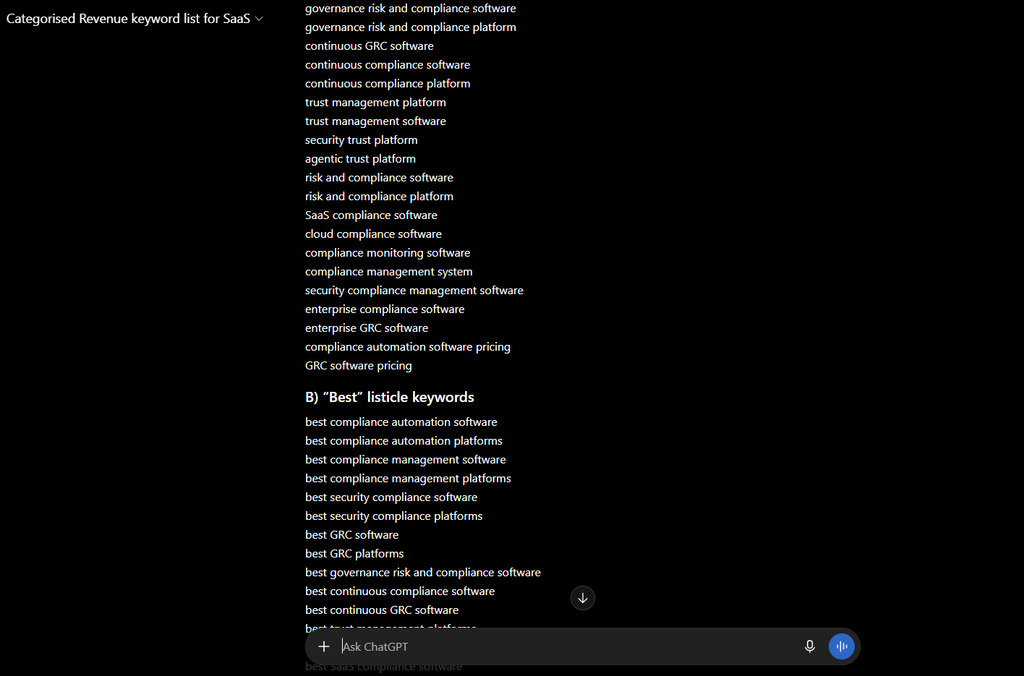
ChatGPT is usually the first generative AI tool I use when researching an unfamiliar SaaS business.
Or at least it was before I built RevPages.
You can ask ChatGPT to analyse a website and identify the company’s product category, features, use cases, target industries, customer problems and principal competitors.
From there, it can generate keyword ideas for different types of commercial pages.
For example, you could ask it to produce categorised keyword ideas for:
- Ten competitor comparison keywords
- Ten competitor alternative keywords
- Ten feature-related keywords
- Ten industry landing-page ideas
- Ten customer problem or use-case searches
- Relevant templates or calculators
I even created a custom SaaS keyword finder GPT to do this by simply entering the URL.
This provides a much better starting point than entering one broad keyword into a conventional tool and working through thousands of loosely related suggestions.
ChatGPT is also useful for categorising an existing keyword list, identifying likely search intent and suggesting the most appropriate page type for each term.
However, I would never trust search volumes, keyword difficulties or traffic estimates produced directly by ChatGPT. Unless it is connected to an external data source, it doesn’t have access to a live keyword database and may confidently produce figures that are completely invented.
I use ChatGPT to find directions worth investigating, not to make the final prioritisation decisions.
I would then have to get the search data from Ahrefs and copy the data into my SEO revenue forecasting spreadsheet to make the ultimate decision on which pages to focus on first – based on potential revenue uplift and chance-of-ranking.
3. Claude
Best for: Analysing large customer, product and competitor documents
Claude can perform many of the same tasks as ChatGPT, but I find it particularly useful when the research involves a large amount of source material.
I can provide it with:
- Customer interview transcripts
- Sales-call notes
- Product documentation
- Customer reviews
- Support queries
- Competitor landing pages
- Existing keyword exports
- Previous content plans
Claude can analyse this information and identify recurring problems, language patterns, feature requirements and objections that could translate into valuable search topics.
This is especially helpful for SaaS companies operating in specialised markets. Internal teams often use terminology that differs from the language customers use when describing their problems. Analysing sales conversations and customer reviews can uncover phrases that would otherwise be missed during conventional keyword research.
Claude can also help organise a large keyword list into themes, funnel stages and suggested page types.
As with ChatGPT, its recommendations still need to be checked against actual search data. A phrase might be frequently used in sales calls without having measurable Google search demand. Alternatively, it could reveal a commercially important zero-volume keyword that is still worth targeting.
Claude is best used for uncovering the customer insight behind the keywords, with another platform used to validate and prioritise them.
Discover your biggest SEO revenue opportunities in 90 seconds
Instantly prioritised by revenue potential and ranking achievability
4. Gemini
Best for: AI-assisted research within the Google ecosystem
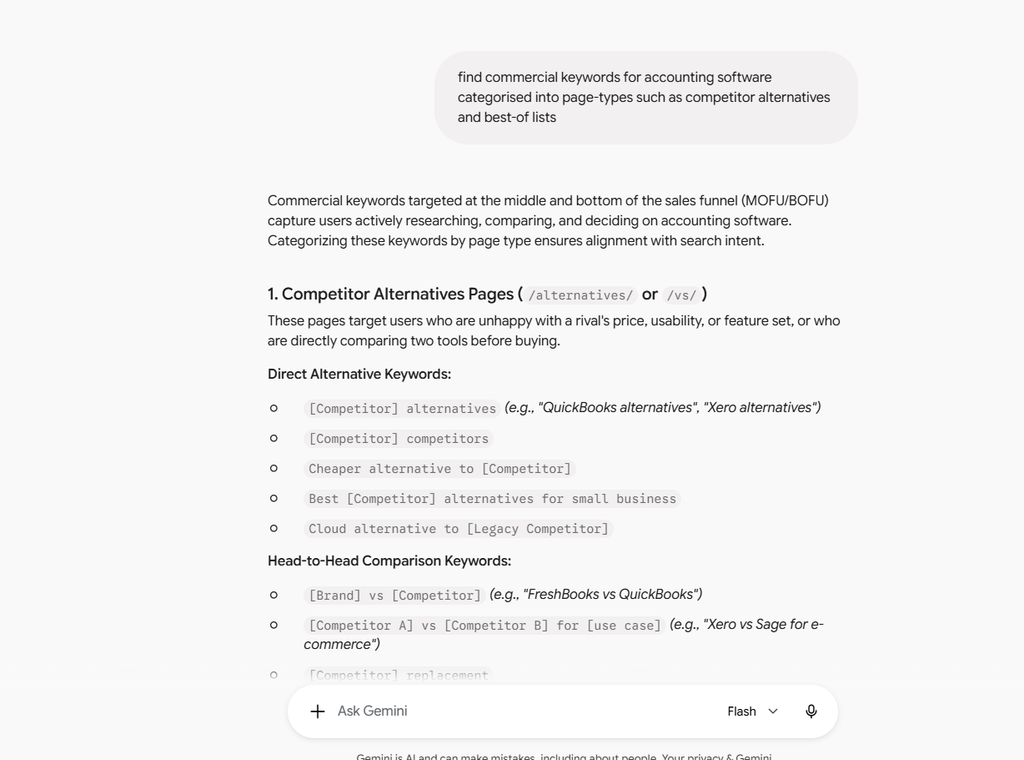
Gemini is another capable tool for analysing SaaS companies and generating initial keyword ideas.
Its main advantage is its connection with Google’s wider ecosystem. Depending on the version and integrations available to you, Gemini can help analyse documents, spreadsheets and other information stored in Google Workspace.
That can make it convenient for marketing teams whose customer research, content plans and keyword data already live in Google Docs and Sheets.
You can use Gemini to:
- Analyse a SaaS website and summarise its positioning
- Generate keywords based on features and industries
- Group keywords by search intent
- Suggest related questions customers may ask
- Turn a keyword export into a structured content plan
- Identify gaps in an existing list of pages
I would still treat Gemini as an analytical assistant rather than a replacement for Google Search Console, Ahrefs, Semrush or another reliable SEO data source.
It can help you understand what to investigate, but measurable demand and ranking potential should be validated separately.
5. Perplexity
Best for: Source-backed market and competitor research
Perplexity is particularly useful during the market-research stage of SaaS keyword research.
Where a standard AI chatbot may answer from its existing knowledge, Perplexity actively searches for supporting sources. This makes it useful for researching an industry, identifying emerging competitors and understanding how a particular software category is described online.
For example, you could use it to investigate:
- The leading tools within a SaaS category
- New competitors that do not yet appear in conventional databases
- Common problems discussed by customers
- Industry terminology and acronyms
- Regulatory changes affecting the market
- Software categories related to the main product
- Questions being discussed across forums and specialist websites
This research can reveal possible comparison, alternatives, industry and use-case pages.
Perplexity’s source links also make it easier to check where an idea has come from. That doesn’t automatically make every answer accurate, but it provides a better starting point for verification.
Its weakness is that it is not a dedicated SEO platform. It won’t replace proper search-volume, difficulty and ranking analysis. I would use it to develop a better understanding of the market before moving the resulting ideas into a keyword tool.
In all honesty, when you’re seeding initial keyword ideas; ChatGPT, Gemini and Perplexity all do an equally great job – so it’s best to stick with the platform you already know and use.
6. Semrush
Best for: Combining AI assistance with an extensive SEO platform
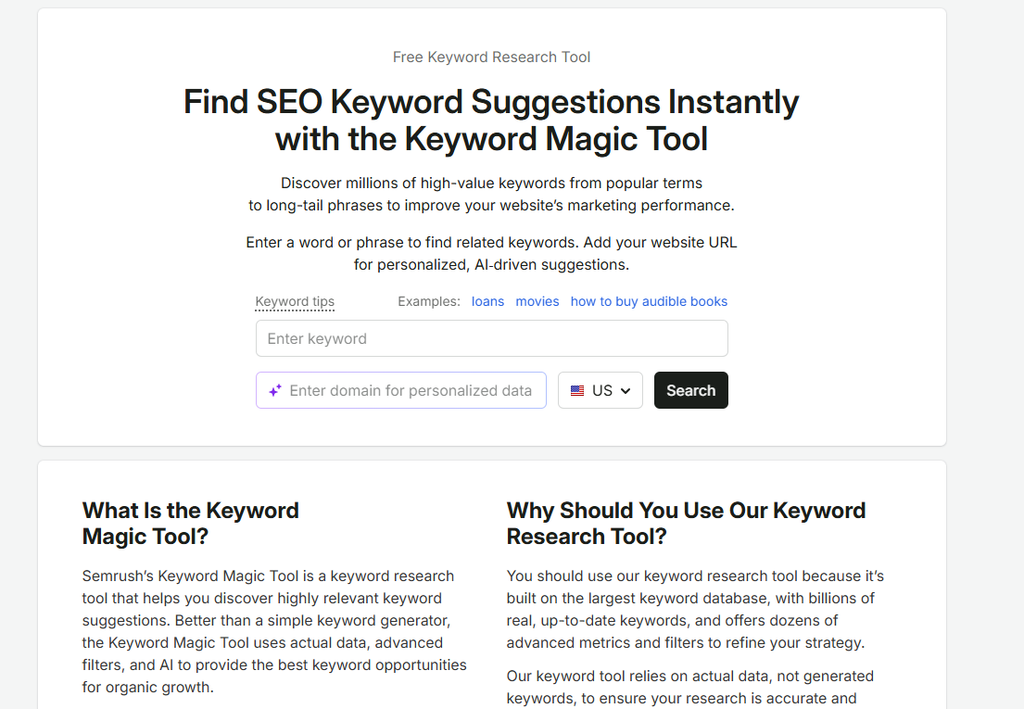
Semrush is one of the big-player SEO platforms and now incorporates AI across various parts of its product.
Unlike general-purpose generative AI tools, Semrush has its own keyword, competitor and ranking data. This means you can move from an initial idea into measurable SEO research without constantly transferring information between unrelated platforms.
For SaaS keyword research, it can help you:
- Find related keyword suggestions
- Analyse the terms competitors rank for
- identify keyword gaps between competing websites
- Review search intent
- Estimate ranking difficulty
- Build keyword clusters
- Track rankings after pages are published
Its competitive research is particularly useful. Entering the domains of several competing SaaS businesses can reveal product categories, integrations, features and use cases that don’t immediately appear through brainstorming alone.
The downside is that a platform with this many capabilities can produce an enormous amount of data. You can quickly end up with thousands of keyword suggestions without a clear way to decide which ones could actually generate revenue for your business
Semrush isn’t really a generative AI keyword-ideation tool in the same sense as ChatGPT, Claude or RevPages. Its primary strength remains its huge database of keyword and competitor data, enhanced by AI-based scoring, clustering, recommendations and content generation.
7. Ahrefs
Best for: Validating demand and assessing ranking opportunities
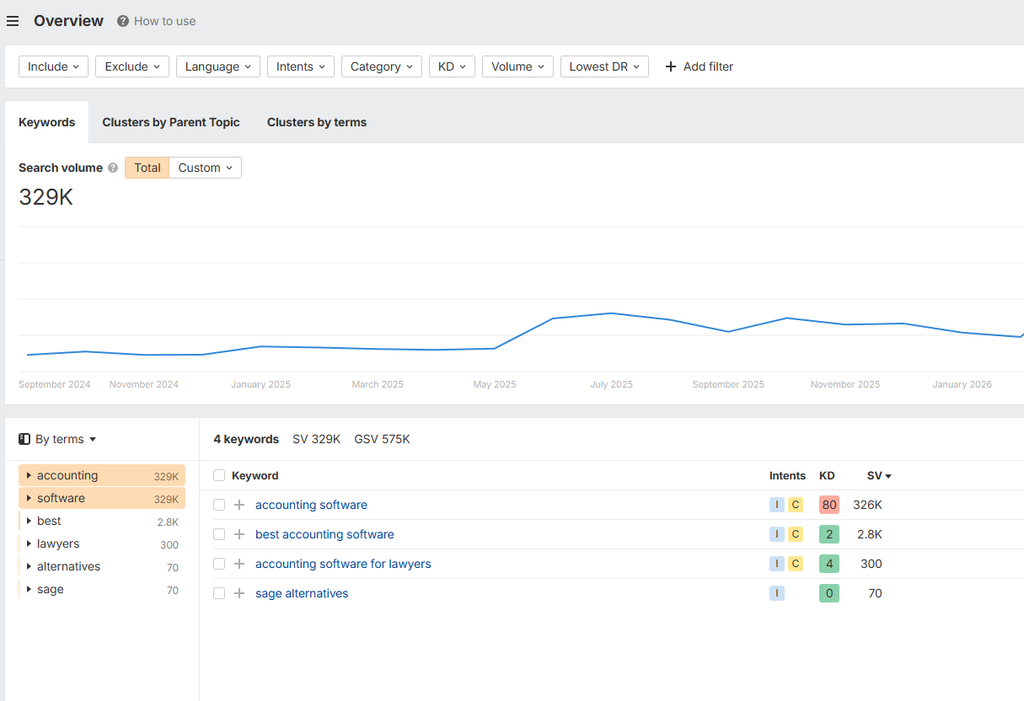
Ahrefs is one of the tools I have used most extensively throughout my SEO career.
I find it particularly valuable after generative AI has produced an initial list of ideas. I can enter those ideas into Keywords Explorer and check whether there is genuine demand, how difficult the SERP appears and which pages currently rank.
Ahrefs is useful for:
- Checking estimated search volume
- Finding keyword variations
- Reviewing the current SERP
- Assessing ranking difficulty
- Analysing competitor pages
- Discovering keywords competitors rank for
- Checking backlink requirements
- Identifying existing pages that could be improved
The final point is often overlooked. SaaS keyword research shouldn’t only be about creating new pages.
If an existing page ranks near the bottom of page one or somewhere on page two, improving it might generate results much faster than writing an entirely new article. Ahrefs makes it relatively easy to identify these existing opportunities.
Its AI features can accelerate parts of the research and content process, but I still see the underlying keyword and competitor data as its principal strength.
As with Semrush, the main challenge is prioritisation. Ahrefs can show you thousands of potential keywords, but you still need to connect those opportunities to your product, conversion rates and customer value.
Turn hours of keyword research into 90 seconds
Automatically discover high-intent opportunities, forecast their revenue potential and see what to target first.
How I use generative AI for SaaS keyword research
I don’t view generative AI as a direct replacement for keyword research tools.
I use it to improve the thinking that happens before and around the data.
My process for StandOut CV or LinkQuest SaaS clients generally looks like this:
1. Understand the product and customer
I start by analysing the website, product and customer problems
The goal is to understand what the product does, who buys it, what problems it solves and which alternatives customers may be considering.
I’ll normally use ChatGPT for this in addition to manually checking out the site.
2. Generate ideas by page type
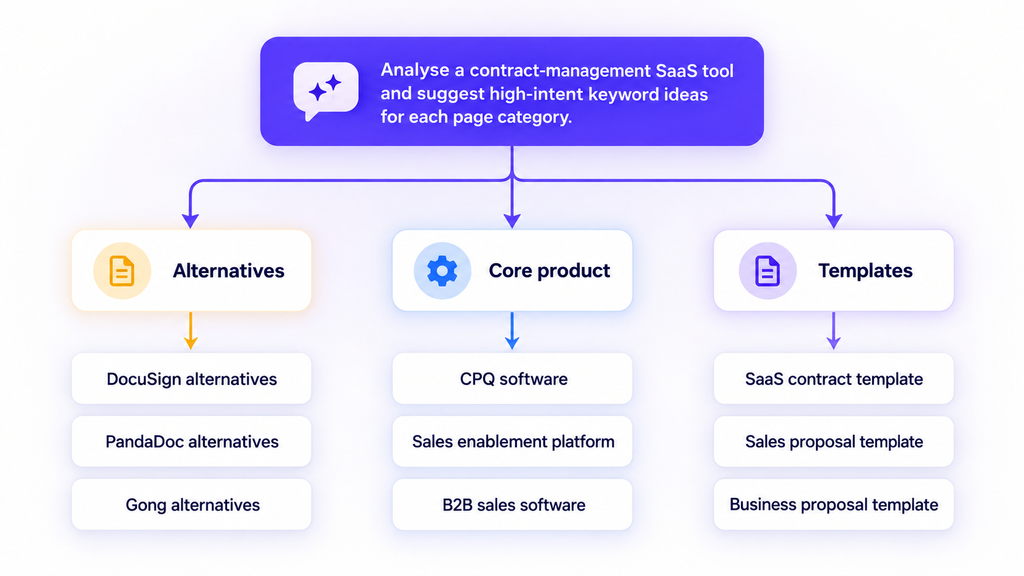
Instead of asking AI for a generic list of keywords, I ask for ideas within commercially relevant categories.
For SaaS companies, I ask for the proven profitable page types: alternatives, comparisons, industries, features, use cases, integrations, templates and core product searches.
This produces a much more focused list of high-intent SaaS keywords, grouped into useful categories.
3. Validate the keywords
Next, check the suggestions against a genuine keyword database.
This is as simple as copying the keywords into Ahrefs
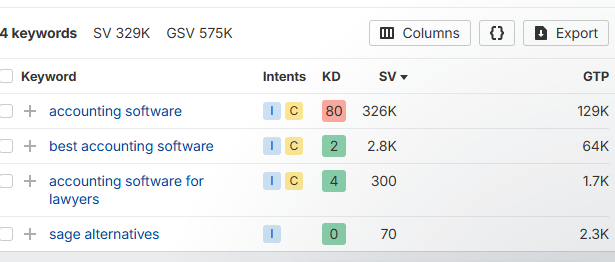
Look at search volume, keyword difficulty, related terms and the actual pages ranking in Google. A keyword may sound perfect but have no meaningful demand, or its SERP may reveal an entirely different intent.
Pull all of this data into a spreadsheet, or use my SEO revenue forecasting spreadsheet to save time.
4. Check current performance
Staying in Ahrefs, determine whether the website already has a relevant page and whether it ranks for the term.
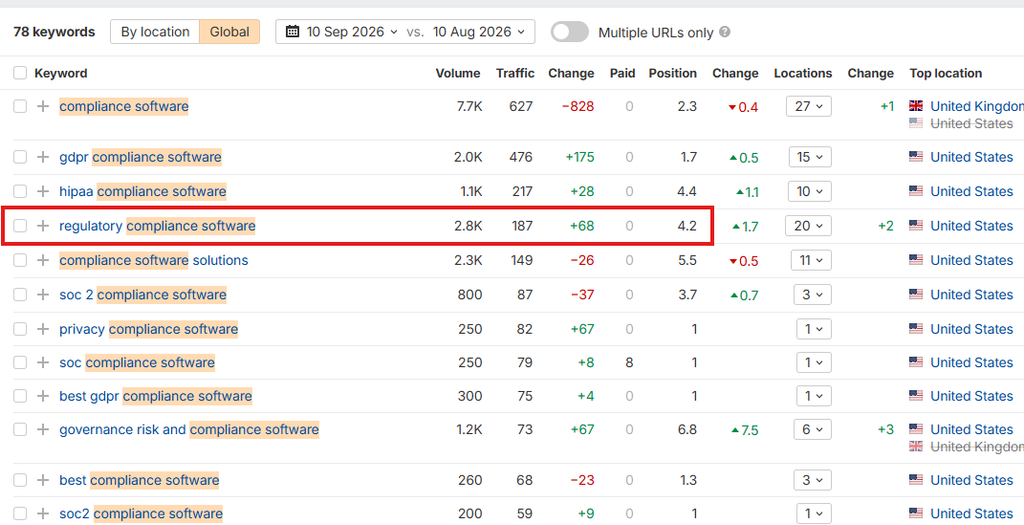
It’s important to know:
- Do you already have a live page for the term?
- If so, where does it rank?
- Do you need to create a new page, or update an existing one
You can check keywords individually inside Ahrefs, or pull all of your site’s keyword data into a separate tab on your spreadsheet then add a Vlookup to pull the ranking data through into the relevant field.
5. Estimate the commercial value
Search volume alone tells you very little about business value.
A keyword receiving 50 searches per month could be far more valuable than one receiving 5,000 if the smaller term is searched by people actively comparing products and preparing to buy.
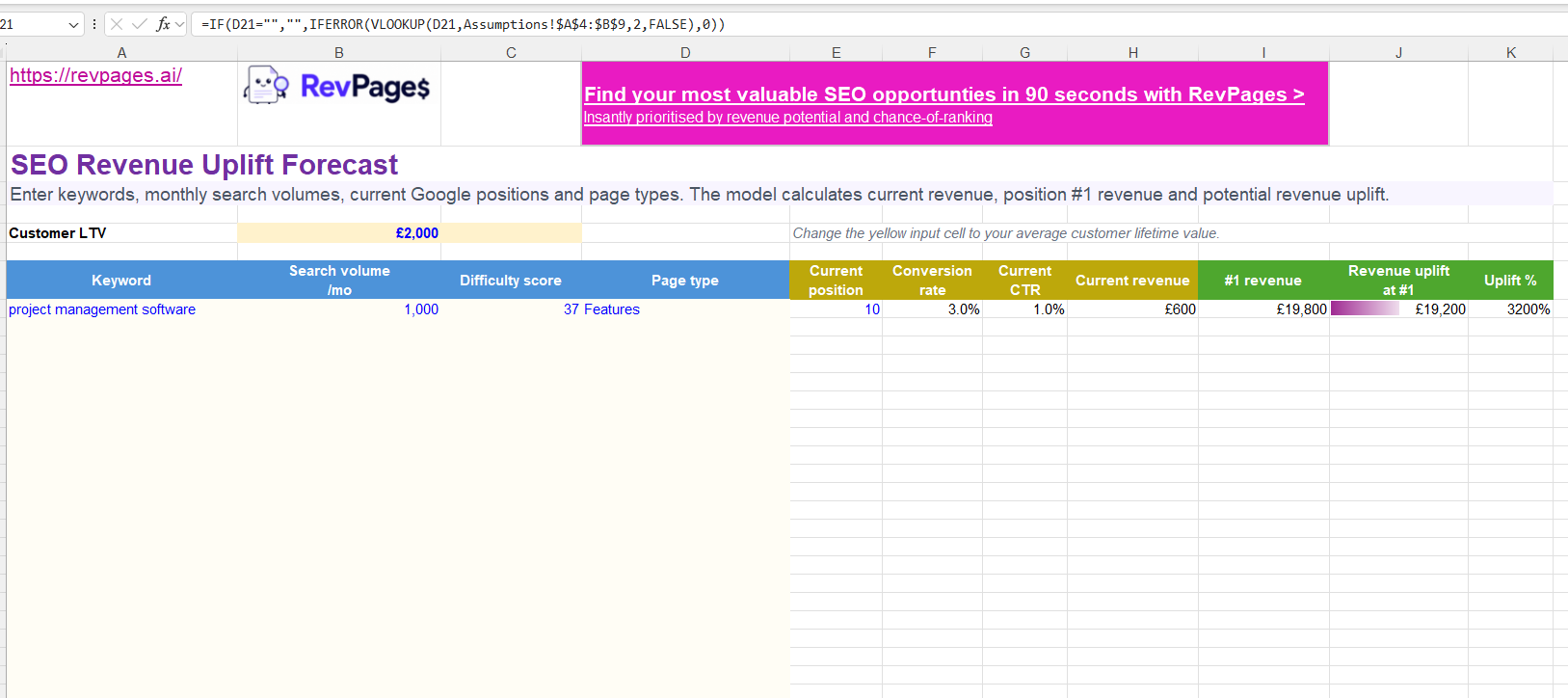
I estimate potential traffic, likely conversion rate and customer lifetime value to work out exactly how much revenue each page could generate, if it were to reach position #1 in Google for it’s target term.
I use a standard SEO revenue forecasting process for this – which you can get for free by using my revenue forecasting spreadsheet – it’s also handled automatically in RevPages.
6. Prioritise the opportunities
Finally, I work out which pages are most likely to start generating significant revenue for the business quickly.
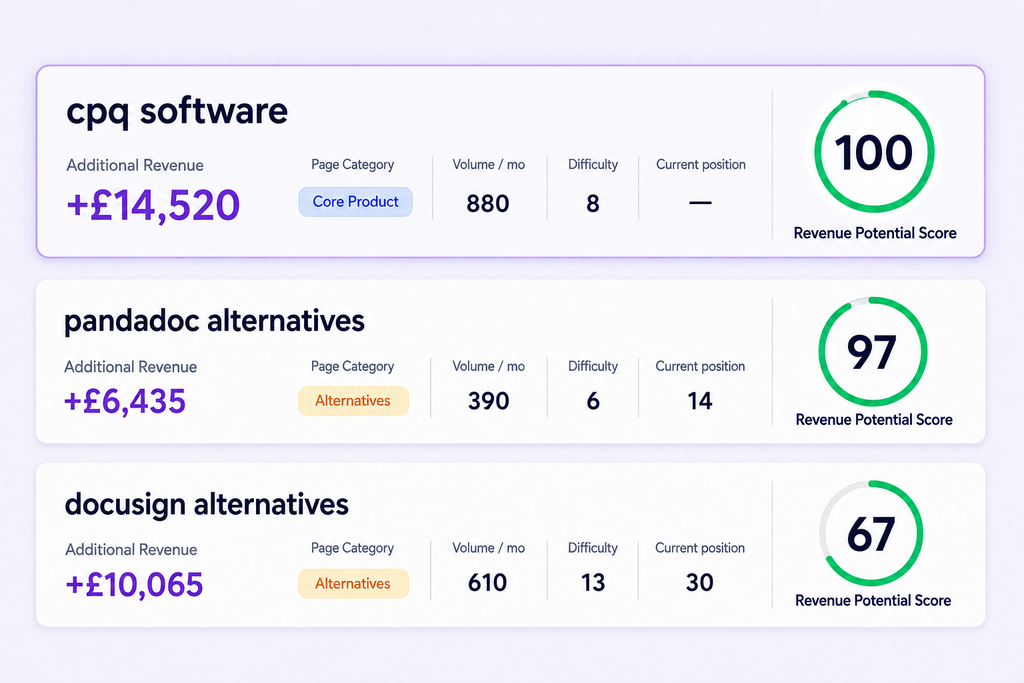
This is done by scoring each opportunity based on its revenue potential and chance-of-ranking.
We don’t want to simply prioritize pages with high revenue potential but extremely low chances of ranking – nor do we want to prioritize pages that we could rank for in days, but won’t attract many customers.
RevPages does this automatically to show you which pages deserve your time and resources first.
Can generative AI replace conventional keyword research tools?
Not completely.
Generative AI is excellent at understanding products, generating ideas, organising information and recognising patterns across large amounts of text. It can make the research process significantly faster and reveal opportunities that conventional keyword tools might not suggest.
But it still needs dependable external data.
Without that data, you cannot confidently establish:
- Whether people actually search for a keyword
- How much search demand exists
- Which websites currently rank
- Whether you already have a relevant ranking page
- How difficult the competition will be
- Whether the opportunity is commercially worthwhile
The strongest approach is therefore to combine AI analysis with genuine search and competitor data.
That is ultimately why I built RevPages. I wanted the speed and contextual understanding of generative AI, but I also wanted the resulting opportunities to be validated, commercially assessed and arranged into a practical SaaS SEO roadmap.
Generative AI can give you more ideas than ever before. The real advantage comes from knowing which of those ideas are worth acting on.