
SEO business case builder
Build a convincing case for SEO investment | Show business leaders the potential returns, costs and strategic benefits in one professional slide deck.
Start editing the template instantly and download in PDF – No login required

 Andrew Fennell | Last updated 19 November 2026
No account required ❌
Forecasts builders and ROI calculators inside 📈
Instant PDF download ⬇️
Fully customisable templates🎨
Create an SEO business case to secure investment
Getting buy-in for SEO is notoriously difficult. Especially when results are getting harder to predict.
After years of growing businesses through organic search, I wanted to help SEO and marketing teams make a convincing case.
So I created this free SEO business case builder that guides you from executive summary and opportunity sizing, right through to ROI and resource requests.
Customise the content, add your branding and data, and download a professional slide deck.
How to create an SEO business case
With the free business case builder
An SEO business case helps marketing teams secure budget and resources by showing CMOs, CFOs and other business leaders why SEO deserves investment.
It should explain the opportunity, proposed approach, costs and expected returns - backed by realistic forecasts and a clear delivery plan.
The aim is to present a clear case backed by credible data, while being upfront about the risks and how long SEO can take to deliver results. In my experience, business leaders want realistic projections and transparent assumptions, and quickly lose confidence in vague promises built on weak data.
Here's how to create a successful presentation using The RevPages SEO business case builder.
Executive Summary
Give decision-makers the case at a glance
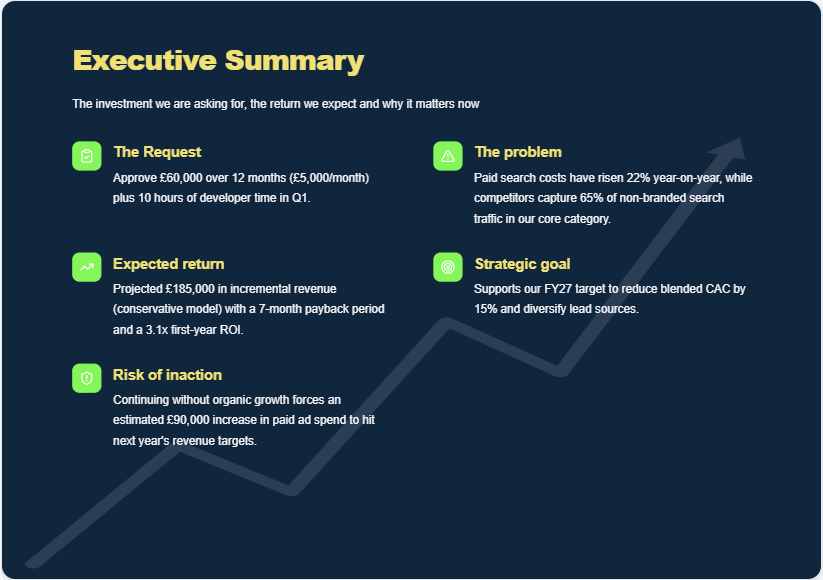
Summarise what you’re asking for, why it matters and what the business could gain from your initiative. This page should give leaders enough context to understand the proposal before diving into the details.
- The request: State the budget and resources you need, the proposed campaign length and what you want approved.
- The problem: Explain the business challenge SEO will address, such as limited inbound leads, rising acquisition costs or poor visibility for valuable searches.
- Expected return: Highlight the main financial outcomes that leadership will be interested (mainly additional customers or revenue) and the proposed timeframe. If you've not yet created financial forecasts you can use our free forecasting spreadsheet, ROI calculator or AI SEO revenue forecasting tool.
- Strategic goal: Connect the investment to a specific business priority, such as entering a new market, growing sales or reducing reliance on paid advertising.
- Risk of inaction: Briefly explain what could happen if the business maintains its current approach, such as competitors taking the lion-share of search demand or rising PPC costs.
Explain the opportunity
Show the demand your business could capture
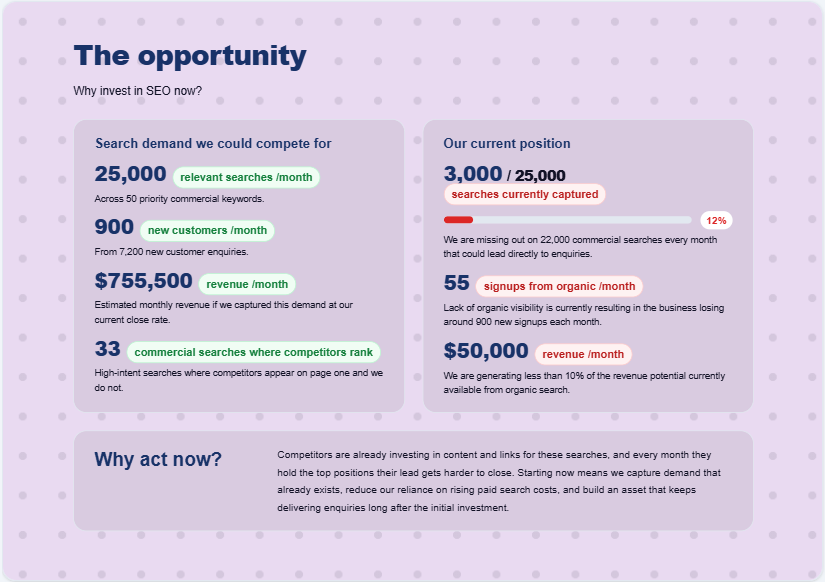
Show decision-makers that customers are already searching for what the business offers, and where you could do a better job of reaching them. Adding relevant and accurate figures will make this more convincing than broad claims about SEO’s potential.
- Search demand: Show how many relevant searches take place each month and the traffic and revenue they could generate. Focus on searches with clear buying intent and explain the assumptions behind the numbers.
- Current position: Highlight where rankings and visibility are weak, including searches where competitors are doing better. Demonstrate the revenue currently being missed out on.
- Why act now: Give a specific reason to prioritise SEO, such as a product launch, rising PPC advertising costs or an underserved market - explain why starting now makes sense for the business.
Search opportunity details
Put the numbers behind the opportunity
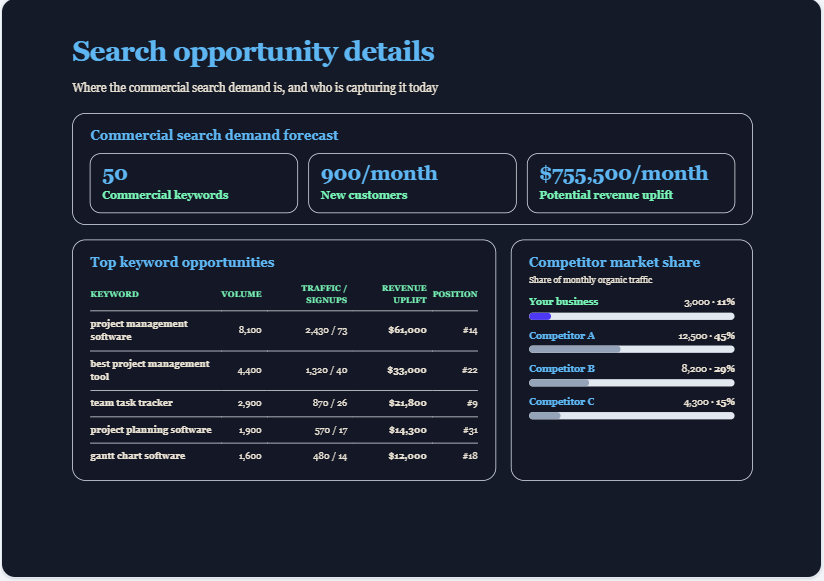
Use this optional page for leaders who want to dig deeper, such as the CMO. Show which keywords offer the greatest commercial potential and how your search visibility compares with competitors.
- Search opportunity overview: Enter totals for your target keywords and the customers and revenue they could generate. Make the timeframe and forecast assumptions clear.
- Top keyword opportunities: Highlight up to five valuable keywords, including current rankings, search demand and potential customers and revenue.
- Competitive search landscape: Compare your business with competitors using a consistent metric, such as estimated organic traffic or page-one keyword coverage.
Strategic alignment
Connect your SEO plan to the goals leaders care about
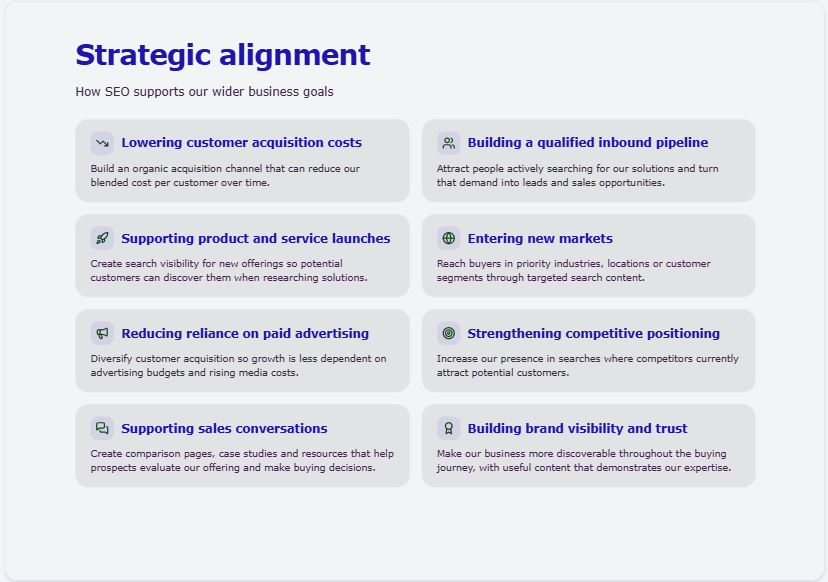
Use this page to show how SEO supports the business’s existing priorities. Our case builder tool contains examples for some of the most common business goals used, such as:
- Lowering customer acquisition costs: Explain how organic growth could help reduce the average cost of winning a customer over time.
- Building a qualified inbound pipeline: Show how you’ll attract people searching for your solutions and turn that demand into sales opportunities.
- Reducing reliance on paid advertising: Describe how SEO could diversify acquisition and make growth less dependent on advertising spend - especially how the compounding effects of SEO reduce CAC over time.
- Building brand visibility and trust: Explain where useful content can help potential customers discover your business and gain confidence in its expertise.
- Strengthening competitive positioning: Highlight important searches where greater visibility would help your business compete for buyers’ attention.
Expected results
Show what the investment could deliver
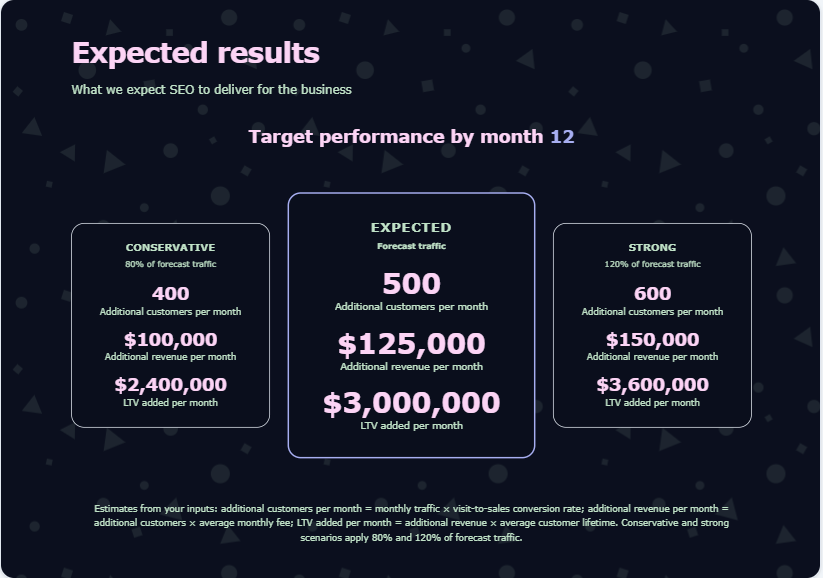
Translate the SEO opportunity into outcomes leaders care about: additional customers and revenue. Show a realistic range of results, explain your assumptions and make clear when you expect to reach them. You can use RevPages to forecast SEO revenue and support your projections.
- Additional customers: Estimate how many new customers SEO could generate using your projected additional traffic and conversion rates.
- Revenue and lifetime value: Show the revenue those customers could generate, clearly distinguishing revenue earned during the forecast period from estimated customer lifetime revenue.
- Conservative, expected and strong forecasts: Present three scenarios to show how results could vary. Explain which assumptions change between them, rather than presenting the expected outcome as a certainty.
Your approach
Explain how you’ll turn the opportunity into results
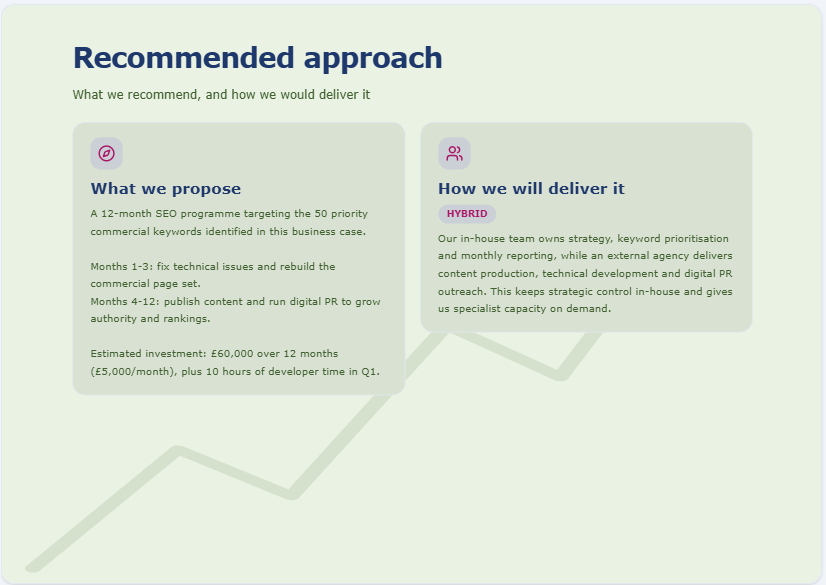
Outline the work you’re proposing and who will deliver it. Keep it short and sharp - Execs need to understand what they’re approving, but don't need a detailed SEO task list.
- Project overview: Summarise the scope, priorities and main activities, such as improving technical performance, creating commercial pages or updating existing content. Explain why these are the right areas to focus on.
- Delivery approach: Set out whether the work will be handled in-house, by an agency or through a combination of both. Clarify responsibilities and why the approach suits your budget, skills and available capacity.
Resource requirements
Make the full investment needs clear
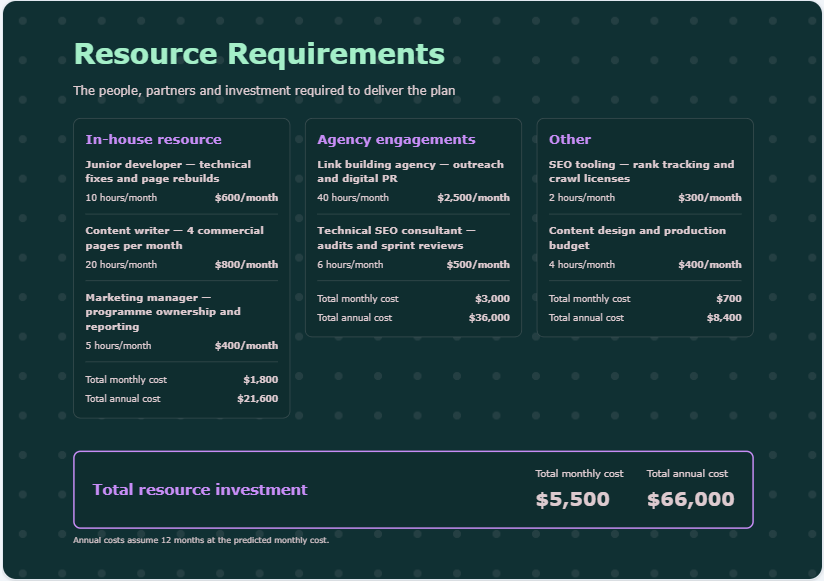
Use this page to show exactly what the proposed work needs in people, time and money. Include internal commitments alongside external fees so leaders can see the full cost of delivery.
- In-house resources: List the teams or roles involved, their required hours and associated costs. Include support from content writers, developers and subject-matter experts.
- External resources: Break down agency, freelancer or consultant fees, explaining what each will deliver and any internal time needed to manage them.
- Other costs: Include tools, software and any additional expenses. Separate one-off costs from recurring charges.
- Total time and cost: Bring everything together over the proposed campaign period to show monthly and annual investment totals.
Project timeline
Show what happens when
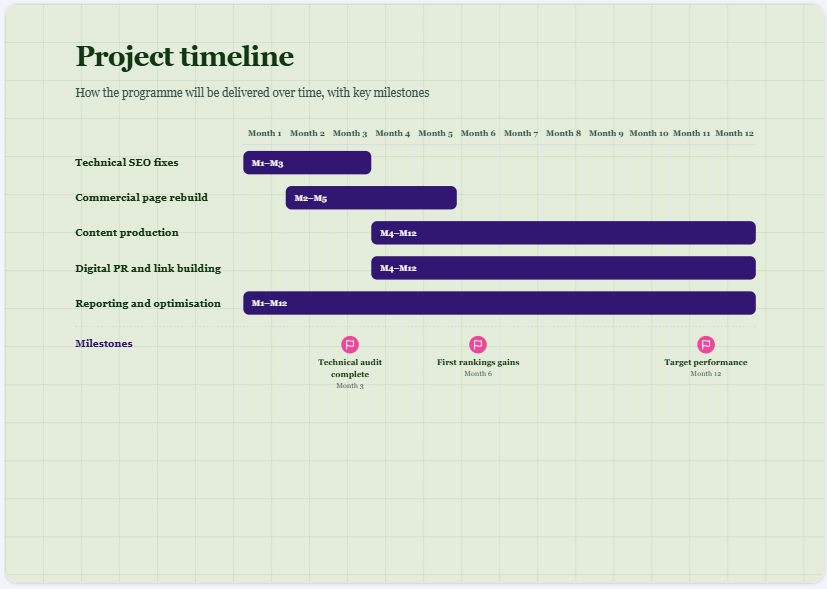
Give leaders a realistic view of how the work will progress and when results could start to emerge. The timeline chart should give execs a birds-eye view of the programme.
- Project phases: Map out the main stages, such as research, technical improvements, content roadmap and ongoing optimisation. Show when each starts and finishes, including work that overlaps.
- Key milestones: Mark important deliverables and review points, such as completing technical fixes, publishing priority pages and assessing initial performance.
Return on investment
Help leaders weigh the costs and returns
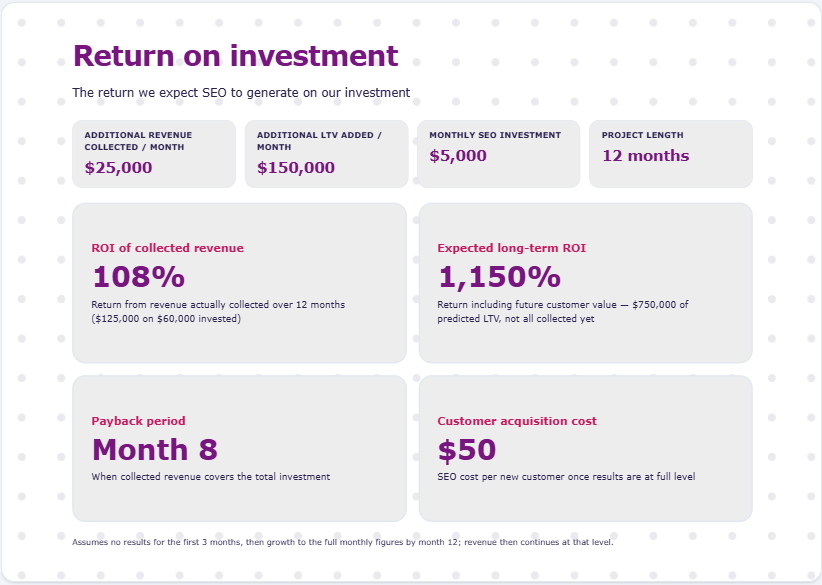
Here you bring the forecast and costs together so leaders can assess whether the investment makes financial sense. Be clear about the period you’re measuring and distinguish returns earned during the campaign from longer-term customer value.
- Costs: Include the full investment over the selected period, covering internal resources, external support and tools.
- Income: Show the additional revenue forecast from the campaign, keeping it consistent with your expected-results figures.
- ROI on monthly revenue: Compare revenue earned over the forecast period with costs over that same period. Include gross margin where available so the calculation reflects profit rather than revenue alone.
- ROI on LTV: Show the potential lifetime return from customers acquired during the campaign. I’d label this separately, as much of that value may arrive after the forecast period.
- Payback period: Show when cumulative returns are expected to cover cumulative costs. Base this on revenue or gross profit earned over time, rather than counting LTV upfront.
- Customer acquisition cost (CAC): Divide campaign costs by the additional customers forecast for the same period. Compare this with your existing CAC where you have a reliable benchmark.
Ownership and KPIs
Make accountability part of the plan
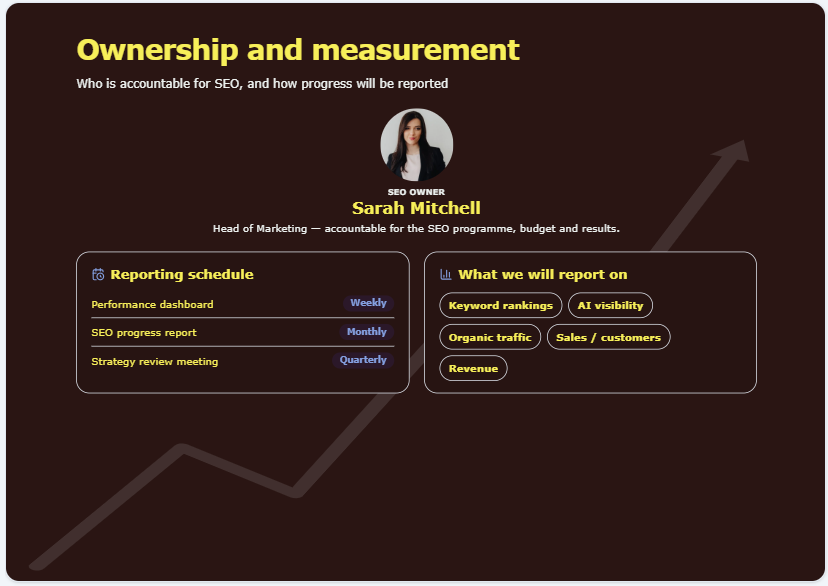
Show who’s responsible for delivery and how leaders will know whether the investment is working. Set clear ownership, a reporting routine and measures that connect SEO progress to business results.
- Owner and team: Name the project owner and the people supporting delivery. Clarify who handles implementation, approvals and performance tracking.
- Reporting schedule: Explain how often you’ll share updates and review progress. Include key checkpoints for assessing results and adjusting the plan.
- Metrics reported: List the measures you’ll track, such as search visibility, qualified traffic, leads, customers and revenue. Include starting figures and targets where available so progress is easy to assess.
Risks and mitigation
Be upfront about what could go wrong
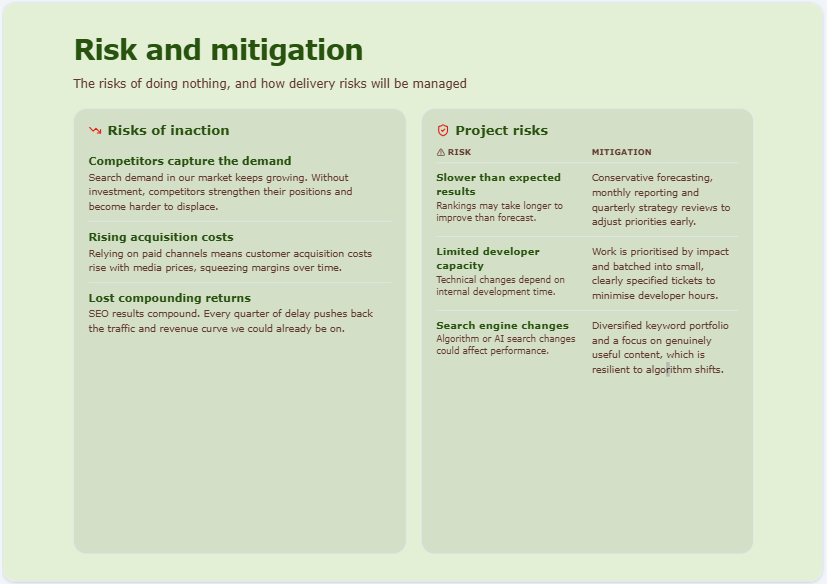
On this slide show that you’ve considered the risks of both investing and maintaining the current approach. Being honest about uncertainty - and explaining how you’ll mitigate core risks - makes the case more credible.
- Risks of inaction: Explain what the business could lose by continuing as-is, such as missed sales opportunities, reliance on paid advertising or competitors gaining visibility. Keep these points grounded in your earlier evidence.
- Project risks and mitigation: Outline what could affect delivery or results, such as limited development capacity, content delays or slower-than-expected growth. Pair each risk with a practical response, such as agreeing resources upfront, setting approval deadlines or reviewing performance against conservative forecasts.
Approval and next steps
Make it easy to say yes and get started
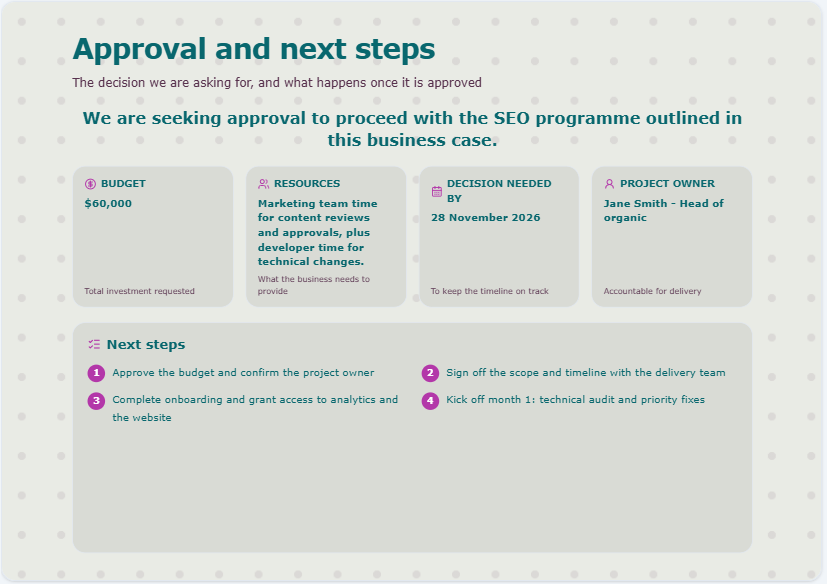
Finish your business case by making the decision clear: what needs approving, who will take responsibility and what happens next. Keep this brief so leaders leave knowing exactly what you’re asking them to do.
- Summary of request: Restate the budget, resources and campaign period you want approved, keeping these consistent with the rest of your case.
- Project owner: Name the person responsible for moving the project forward and coordinating delivery.
- Decision needed by: Include a realistic deadline, explaining any connection to the proposed start date or business priorities.
- Next steps: List the immediate actions following approval, such as confirming the team, appointing an agency or scheduling the kick-off. Add owners and dates where useful.
Tips for building a robust SEO business case
- Build forecasts you can defend: Use relevant search data and your own conversion rates where possible. I’d show conservative, expected and strong scenarios, with the assumptions clearly explained.
- Remember who you’re presenting to: A CFO will want to understand costs and returns; a CMO may want more detail on strategy. Lead with business outcomes and keep technical detail optional.
- Include the full investment: Account for internal time, content, development and software alongside agency fees. Overlooking these makes the budget harder to defend later.
- Be realistic about timing and risks: Explain when results could emerge, what could delay them and how you’ll respond if performance falls short.
- Make the decision clear: Finish with the exact budget and resources you need, who will own delivery and what happens after approval.
What’s making SEO business decisions harder in 2026?
AI Overviews are reducing clicks
Ranking well doesn’t necessarily bring the traffic it once did. Pew Research Center’s study of US browsing behaviour found that users clicked traditional results on 8% of visits with an AI summary, compared with 15% without one. Try to build this reduction in clicks into your forecasts where you can.
Attribution doesn’t capture the whole journey
A buyer might discover your business in an AI answer and return later through another channel, making the original influence difficult to establish. Even Google’s dedicated AI reporting focuses on impressions, leaving gaps between visibility and actual sales. I’d explain those limits and assess qualified leads, customer acquisition and revenue alongside visibility.
AI visibility is a moving target
AI citations can change quickly, making firm promises difficult. An Ahrefs study tracking roughly 37,500 citations across five AI tools found that 50–83% disappeared the following day, although many subsequently returned. That makes a single visibility snapshot a weak basis for an investment case. I’d focus on trends across repeated measurements and keep AI visibility targets separate from revenue commitments.
How the SEO business case builder works
Create a tailored, professional case for SEO investment in four straightforward steps.
1. Choose your business case pages

Choose the pages you need to make your case, from the executive summary and search opportunity to forecasts, resource requirements and next steps. Add custom pages to suit your project and audience.
2. Add your project details and forecasts

Enter your business goals, current performance, keyword opportunities and proposed SEO activity. Build a forecast using the built-in calculators or upload your own charts. Pre-written content helps you get started.
3. Customise the content and design

Edit each section to reflect your strategy, budget, timeline and expected returns. Add your company logo and customise the design to match your branding, creating a pitch ready for your leadership team.
4. Preview and download your business case

Check every page in the live preview, then download your finished business case as a professional PDF - with no account required. You can also create a free account to save your progress and return to it later.
Example SEO business case