
SaaS SEO ROI calculator
Find out how many customers you need to cover your SEO investment, explore potential revenue and calculate the return on your existing efforts.
 Andrew Fennell | Last updated 14 October 2026
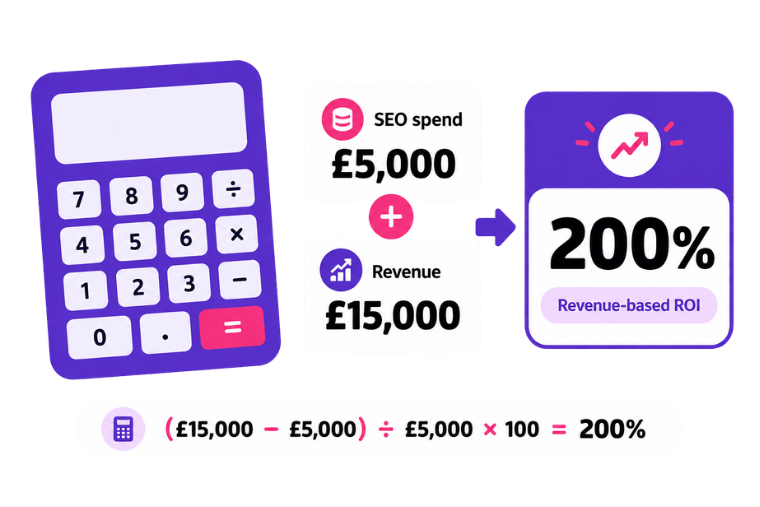
How to use the free SaaS SEO ROI calculator
Set SEO customer targets, explore potential revenue and assess the returns from your existing efforts.
All in one free calculator which uses the RevPages SEO revenue forecasting model. Get instant results, clear charts and a PDF to share. No email required.
Start by choosing the question that matches the decision you need to make.
If you need to decide whether an SEO campaign or agency proposal is commercially viable, choose “How many customers must SEO generate to justify my investment?”
Enter your proposed monthly SEO investment, average customer lifetime value (LTV) and SEO strategy: commercial, informational or mixed.
The calculator shows the customers needed to match your total SEO spending with estimated lifetime revenue after 6, 12 and 36 months. It also estimates the organic traffic required using illustrative conversion assumptions for your selected strategy.
For example, investing £5,000 per month with a £3,000 customer LTV means you need 20 customers to match £60,000 of first-year spending.
Your strategy changes the illustrative traffic requirement, not the customer target. These are acquisition targets, not predictions of when customers will arrive or their payments will cover your costs.
Choose “How much revenue and ROI could SEO potentially generate?” to compare possible outcomes before committing to a budget.
Enter your proposed monthly SEO investment, customer LTV, SEO strategy and a target monthly organic traffic level. Adjust the traffic input to explore different scenarios if you’re unsure on any of the factors..
The calculator shows conservative, expected and strong scenarios, alongside customer estimates, lifetime revenue and revenue-based ROI. Its line chart shows how potential returns change with traffic and where estimated lifetime revenue equals SEO investment.
These scenarios assume the selected traffic level has already been reached. They do not predict how quickly your website will get there.
Its annual figure represents the lifetime revenue of customers acquired over a year - not necessarily money earned within that year.
Choose “What ROI are my existing SEO efforts generating?” when you are already running an SEO strategy and have customer or revenue data to evaluate.
Select a reporting period and enter your total SEO spending for that period. Then choose either:
- Using customers acquired: enter new paying customers attributed to organic search and their average LTV.
- Using recorded revenue: enter revenue attributed to organic search during the selected period.
The results show revenue per £1 invested and revenue-based ROI. Customer mode also shows SEO spending per acquired customer. The comparison chart puts spending beside recorded revenue or estimated customer lifetime revenue.
Save your results as a PDF to keep a record, compare scenarios or send your calculations to a colleague, client or decision-maker.
No email address or signup is required to save your results. Download the PDF and it’s yours to share.
Find your website’s biggest SEO revenue opportunities
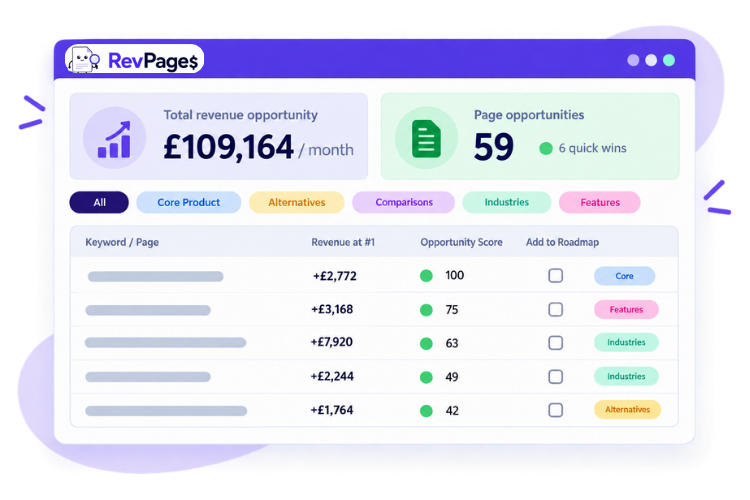
RevPages finds valuable keywords for your website, estimates their revenue potential and prioritises those you have the best chance of ranking for.
How to calculate SEO ROI for a SaaS business
SaaS SEO ROI tells you how much revenue your SEO efforts are generating, in relation to the amount of money you've invested.
It's helpful to forecast SEO ROI for a number of reasons from business cases and investment pitches to SEO proposals.
But there a multiple ways to approach this challenge, depending on your situation, goals and business type.
The SaaS-specific challenge is recurring revenue. A customer who starts paying this month may stay for years, so their first payment can understate their eventual value.
Equally, counting their full estimated LTV as revenue already earned overstates your current return.
So, the RevPages ROI calculator is built to forecast both scenarios - and calculate ROI for both existing and future SEO campaigns.
SEO ROI formulas
These are the formulas the calculator uses for monthly revenue and LTV calculations:
Monthly revenue based calculation

For a revenue-based calculation which tells you how much revenue has actually been generated to date, use the following:
SEO revenue-based ROI = (Revenue attributed to SEO − SEO investment) ÷ SEO investment × 100
For example:
(£75,000 − £30,000) ÷ £30,000 × 100 = 150%
That means £2.50 of revenue for every £1 invested, with £1.50 remaining after subtracting SEO spending.
Revenue based calculation shows the actual banked revenue attributed to organic search during your chosen period. However, it excludes future subscription payments those customers may make, so it doesn’t capture their full potential lifetime value - an important consideration for SaaS businesses.
LTV based calculation
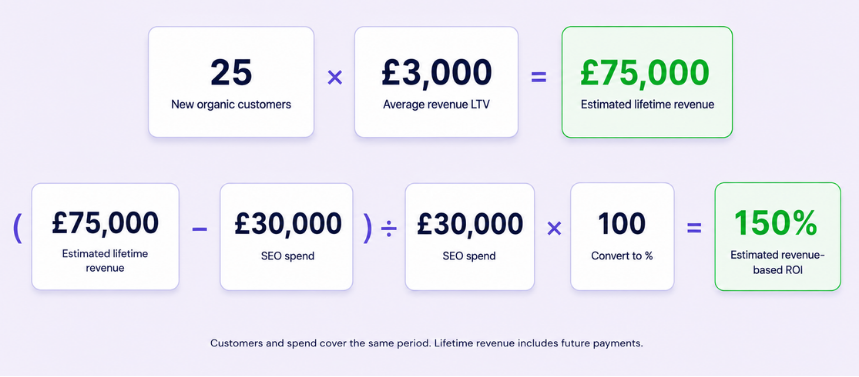
This method estimates the total lifetime revenue of customers acquired through organic search, including revenue they may generate in the future.
First, calculate the total lifetime value of customer acquired during the period:
Estimated SEO customer lifetime revenue = New paying customers attributed to SEO × Average revenue LTV
For example, 25 customers with an estimated LTV of £3,000 would represent:
25 × £3,000 = £75,000 in estimated lifetime revenue
Next, subtract your SEO spending, divide by that spending and multiply by 100:
Estimated revenue-based ROI = ((Estimated customer lifetime revenue − SEO investment) ÷ SEO investment) × 100
If you spent £30,000 on SEO during the period those customers were acquired:
((£75,000 − £30,000) ÷ £30,000) × 100 = 150% ROI
That’s £2.50 in estimated lifetime revenue for every £1 spent on SEO.
Choose recorded revenue or lifetime value
Use recorded revenue to understand revenue earned during a reporting period. Use LTV to assess the longer-term value of customers acquired during that period.
A customer paying £100 per month for an estimated 30 months has a simplified revenue LTV of £3,000. That is not £3,000 earned on signup.
Use your own retention and billing data where possible. Account for churn, discounts and expansion revenue in your LTV assumptions, rather than assuming every customer stays indefinitely.
Include the full cost of SEO
Add together agency or freelancer fees, content production, SEO tools, technical work and the relevant share of internal staff costs.
Keep cost definitions consistent when comparing periods or channels. Comparing fully costed SEO with advertising spend that excludes management and creative costs can be misleading.
Connect organic acquisition to paying customers
Use your analytics, CRM and billing records to connect organic acquisition with customer outcomes. Keep the attribution method consistent and explain whether you are measuring first-touch acquisition, last-touch conversion or another model.
A customer may discover you through Google, return through email and convert after a sales call. Avoid crediting their full revenue to every channel and adding those figures together.
Distinguish branded searches from non-branded discovery where practical. Someone searching for your company name may already know you because of another marketing activity.
Apply a consistent conversion rate
(When forecasting future revenue)
To estimate how many customers your SEO traffic could generate, apply a visitor-to-paying-customer conversion rate. A 1% rate, for example, means 10 paying customers for every 1,000 relevant organic visits.
Use assumptions that reflect your SEO strategy. The calculator uses these illustrative rates:
| SEO strategy | Conservative | Expected | Strong |
|---|---|---|---|
| Commercial | 0.5% | 1% | 2% |
| Mixed | 0.2% | 0.5% | 1% |
| Informational | 0.05% | 0.1% | 0.25% |
- Commercial SEO targets product, comparison and alternative searches. These suggest someone is evaluating a purchase, so the model assumes a higher conversion rate.
- Informational SEO targets guides and educational searches. Visitors may want an answer rather than a product, so the model assumes fewer will become paying customers.
- Mixed SEO combines both approaches, with conversion assumptions between the two.
This is why finding profitable keywords involves more than looking at search volume: a smaller audience with buying intent could generate more customer revenue than a much larger informational audience.
Keep your chosen rate consistent when comparing traffic levels or budgets. These figures are scenario assumptions, not verified industry averages. Where you have reliable data, use conversion rates from comparable pages, and make sure they measure paying customers, not trials or demo requests.
Discover the untapped SEO revenue hiding in your website
RevPages uncovers your biggest SEO opportunities and shows you which ones are most valuable... and achievable.
Why SEO can deliver strong ROI for SaaS businesses
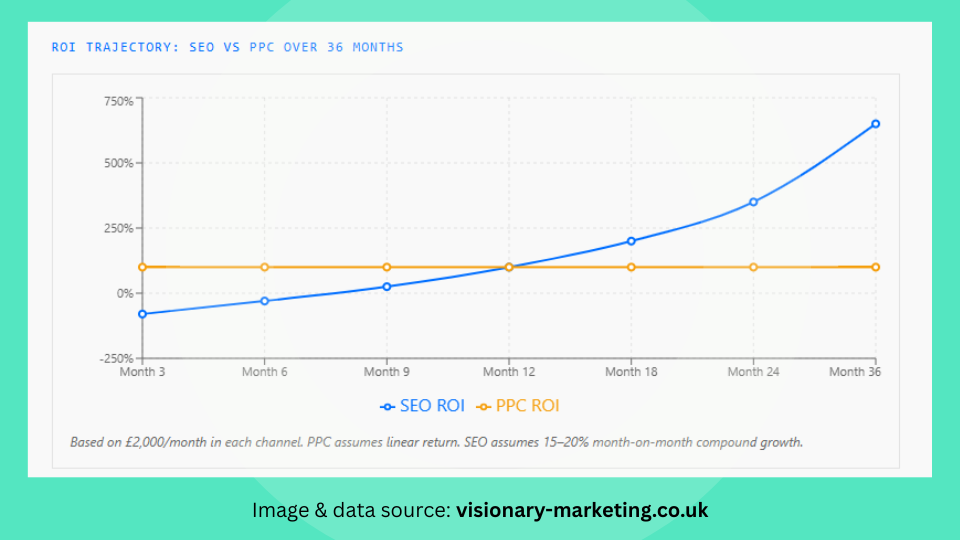
SEO can become a valuable acquisition channel because it connects your product with people searching for a solution and a useful page can continue attracting customers after its initial production cost.
A recent study from Visionary found that SEO delivers a 3.7x higher ROI than PPC.
Attract high-intent visitors
SEO helps you reach people who are already looking for what you sell. Someone searching for “CRM for recruitment agencies” or comparing two software products has a much clearer buying goal than someone casually scrolling through social media.
By targeting these searches with relevant pages, you can attract visitors who have a reason to try your product—rather than chasing traffic that never turns into customers.
Avoid costly CPC fees
With paid search, you pay for every click, whether the visitor becomes a customer or leaves immediately. SEO lets you attract organic visitors without paying that per-click charge.
There are still costs for content, optimisation and maintenance. But if a page keeps bringing in customers, those costs can be spread across more sales, helping reduce your acquisition cost over time.
Compound results over time
Each useful page you publish can become another source of organic customers. As new pages start attracting visitors, older pages can continue contributing too, allowing results to build rather than starting from scratch each month.
For SaaS businesses, this can work on two levels: your content attracts new customers while existing subscribers continue generating revenue. Keeping pages competitive and customers subscribed is what helps that growth translate into a stronger return.
How long does SEO take to deliver ROI?
As somebody who has grown multiple websites from scratch to revenue-generating businesses - one thing I can assure you is that SEO does not generate instant results.
In my experience, notable returns from SEO work usually take at least 3-6 months, but in some cases, established sites can see within weeks - usually if they have done a lot of the ground-work previously.
An Ahrefs article updated in January 2024 reports that its polls of 3,680 respondents pointed to three to six months for SEO results.
But there are many factors that affect how quickly a site can drive revenue from SEO.
Starting rankings, competition, publishing capacity, conversion rate and sales cycle all affect the timeline.
Improving an existing commercial page is a different project from establishing a new website in a competitive category.
What’s a good ROI from SEO for B2B SaaS companies?
There is no universal percentage that makes SEO a good investment. A worthwhile return depends on your margins, retention, payback requirements and alternative uses of the budget.
Whilst there are claims online of SEO generating 700% ROI and more - there is very little way of substantiating such claims - so it’s best not to set your expectations against them.
For interpreting your calculator result, these mathematical reference points are more useful:
It’s better to use your own judgements on what is considered to be a good rate or return for your business.
Judge your results against four questions:
- Does the revenue leave sufficient margin after software delivery and acquisition costs?
- Can the business afford to wait for the cash to arrive?
- Is performance improving as the content matures?
- Does SEO compare favourably with other channels measured on the same basis?
A useful SEO target combines a return requirement with a payback deadline. Assess how much customer value you need to generate, how confidently you can estimate it and how long your business can fund the investment.
Start by using our SaaS keyword research tool to see a realistic estimate of how much your site could generate through SEO.
Find your biggest SEO revenue opportunities with RevPages
You’ve explored the numbers. Now discover where your next SEO customers could come from.
RevPages helps you: